Linguistics and geology, the study of language and the study of the earth—these two fields of inquiry must, at first glance, appear to have little in common. And yet, as practiced in the early nineteenth century, both disciplines confronted a similar problem: how to determine what had happened in the deep past. Linguists at the time were just as intent on discovering the ancient sources of Europe’s languages as geologists were on charting the remote progress of the earth’s surface. In neither case was this an easy task, since both efforts were stymied by a dearth of direct evidence. How were scholars to proceed when the kinds of testimony that conventional historians relied on were missing? Here the uniformitarian method of geologists like Georges Cuvier or Charles Lyell offered a solution: when reconstructing deep history, whether of the earth’s surface or of language, investigators should base their explanations as much as possible on processes at work in the present and should appeal to extraordinary causes only when these present-day forces proved inadequate. Knowledge of how the earth’s surface was being shaped or languages were being formed in the present would then provide the key to what must have happened in the past. In this way, geology came to inform linguistics, giving rise later in the century to a school of uniformitarian linguistics.
Carlo Cattaneo was among the earliest scholars to appreciate the advantages that a uniformitarian method might bring to the study of languages. A polymath and not a specialist, Cattaneo wrote several articles on linguistics in the late 1830s and early 1840s, the most important of which was a review of Bernardino Biondelli’s Atlante linguistico d’Europa. The article originally appeared in the Politecnico for 1841, and ever since its first reprinting has gone by the title, “Sul principio istorico delle lingue europee.” In his review of Biondelli’s atlas, Cattaneo quite deliberately appealed to the terms and methods of geology, especially as they appeared in the work of Georges Cuvier, one of the great naturalists of the early nineteenth century. Cattaneo’s decision to combine linguistics and geology in this way represents an important facet of his realism: it underscores his conviction that the empirical methods of the sciences were the only reliable way to arrive at truth and were as applicable to human affairs as they were to the natural world. It also placed him among those political realists who were wary of ideological abstractions. To reduce human constructions to simplistic ideals or metaphysical fantasies appeared to him unwarranted, if not dangerous, for they were actually the complex and worldly products of human activity at a particular moment in history.
The abstraction that concerned Cattaneo most as he wrote his essay on linguistics was the nation. Since language was generally regarded as one of the fundamental constituents of nationality, ideas on the formation of languages had serious implications for conceptions of the nation. At a time when nationalists—and German Romantic nationalists in particular—were treating nations as abstractions, Cattaneo insisted that they, like the languages defining them, were natural phenomena, the products of everyday historical processes. It was this capacity to address an issue of topical importance that lends Cattaneo’s uniformitarian linguistics its particular interest and significance.
1
The specific question that Biondelli’s atlas posed for Cattaneo was how to account historically for Europe’s modern linguistic landscape with its characteristic blend of dialects and national languages. For an Italian, the existence of many dialects, each at home in its isolated valley, each distinct from others yet united to them by the similarities they all shared with more widely-spoken languages, was one of Europe’s distinguishing linguistic features. Cattaneo’s fascination with how this situation originated demonstrates that he was participating in the historicization of knowledge that affected many fields of inquiry in the early nineteenth century. He understood that languages were not permanent and unchanging, but rather were products of history, rising and falling, coming together and breaking apart in ways that could not be anticipated. Cattaneo also understood that Europe’s principal languages shared certain features, in both vocabulary and structure, with each other and with languages to the east, suggesting that they all belonged to one great Indo-European family that extended all the way to the valleys of the Indus and the Ganges. Sanskrit was the oldest of these languages. At some time in the remote past, it had exerted an influence on Europe, the result of which was the characteristic combination of diversity and unity, of similarity and difference, found among Europe’s contemporary languages and dialects. Europe’s linguistic landscape, then, was the product of a long historical development and the point of Cattaneo’s essay was in large part to explain how this process had occurred.
Cattaneo was not the only scholar at the time to ponder this question of the remote origins of language. Romantics had often delighted in the notion that Sanskrit and the major European languages were structurally related, and had argued that these similarities established the Indian origins of the European nations. As Cattaneo explained their position: “…The majority of modern writers, and especially the Germans, want the European nations to descend, all in a body, from Asia, and properly from the valley of the Indus. And they love to imagine these people, who, drawn up in tribes, descend like a river from Kashmir, some for the Urals, some for the Caucasus, some for the Hellespont, advancing into an empty and silent Europe, first the Gaels, then the Cambrians, then the Thracians, then the Hellenes, then the Goths, then the Slavs.” Cattaneo did not dispute their underlying premise, that an affinity in language implied a historical relationship between peoples. What he did object to was the particular assertion that whole nations originating in India had migrated en masse into an empty European continent, which they then proceeded to fill, from top to bottom, like layers of colored sand in a bottle. His doubts were empirical, for the idea of great migrations into vacant spaces lacked historical evidence and contradicted everyday experience.
This last point was crucial because it emphasized the methodological approach that Cattaneo believed set his own inquiry apart from others. When astronomers plotted the unseen portion of a comet’s path, they based their calculations on the comet’s visible behavior. They assumed, in other words, that the causes behind any phenomenon must be uniform in time and space. Cattaneo believed this assumption lay at the heart of all scientific inquiry, and his work on linguistics would insist on a similar approach: the forces shaping language in the past must be the same as the forces shaping it in the present. When other scholars explained the affinities among Europe’s languages by appealing to mass migrations of Asian populations into an empty continent, they failed precisely on this count: there were no visible parallels for an explanation that defied common sense. Instead of reverting to such fanciful conjectures, Cattaneo would explain Europe’s linguistic development by comparing it to present-day processes such as the expansion of Spanish and Portuguese into the Americas, or Russian into Central Asia, or to well-documented historic processes such as the impact of Latin on the aboriginal languages of southern Europe. As he explained his approach in his review: “I demand only that what is happening today over immense distances and with great speed should be considered a continuation and image of that which might have happened in the much narrower field of our Europe, and in the long course of forty centuries….”
Cattaneo based his alternative version of Europe’s linguistic history on processes that were familiar. The spread of Latin from Italy into Spain, Gaul and the lower Danube was well documented. At no time, as the Roman Empire expanded into southern Europe, did its armies encounter unpopulated expanses. Rather they imposed Latin on aboriginal tribes whose different characters and habits gradually transformed it into the five Romance languages and their many dialects. The same was true of the spread of Spanish and Portuguese into the new world, where the Europeans encountered a continent filled with other peoples, a fact attested to by the racial composition of present-day South America. In neither case did fully formed nations, speaking a uniform language, simply migrate into an unpopulated part of the globe. In both cases the process was far more complex, involving bands of warriors who conquered less developed tribes and imposed their languages on them. The process in its modern guise was best illustrated by the expansion of Russian into Central Asia and Siberia, where commerce was doing what arms had once done before. As the Russians expanded their empire to the east, they encountered a wide variety of peoples speaking any number of languages. Wherever the Russians established colonies, their language became the medium of trade: “All the aborigines engage in commerce with these colonies and therefore in order to understand each other, they must make use of this language as the common interpreter. Their isolated tongues must disappear bit by bit as commerce extends itself to greater distances, and the populations become less singular and more mixed, and the same causes will give greater prevalence to that general and commercial tongue which connects them all. And even if with the course of centuries the power of Russia should dissolve, no human force would be able to eradicate any more this propagation of a common language, transplanted across all of Siberia. In every territory it would make a diverse mixture with the languages of the indigenous tribes; it would be a Slavic skeleton all fleshed out, here with Finnish voices, here with Mongolian, here with Tungusic.”
Cattaneo’s application of these methodological principles to Europe’s linguistic history yielded a picture that was far more complex than the competing theory of migrating nations. He began by supposing that prehistoric Europe had been filled with a great many tribes, much as the Americas had been on the eve of European contact. These tribes spoke distinct languages, like the hundreds of languages spoken by native Americans. Small bands of conquerors, pushed from their Asian homelands by various motives—some religious, some economic, some political—then descended on these tribes and in the act of domination imposed their languages on them. As the languages of the conquerors spread, they interacted with the indigenous languages, giving rise to different dialects and creating overlapping layers of linguistic affinity. Cattaneo’s theory was historically subtle: it explained Europe’s linguistic complexity without recourse to mass migrations or other extraordinary occurrences, and it explained the similarities between the Indo-European languages as well as the even more remarkable differences between them.
Cattaneo began his account with the Pelasgians. They were an ancient people, he suggested, whose language belonged to the Indo-Persian family and whose priestly colonies extended throughout Asia Minor, Greece and Italy long before the coming of the Hellenes. These early adventurers followed the shores of the Mediterranean and the Hellespont, working their way inland and establishing the linguistic affinity between Persia and Greece, and between Greece and Italy. Europe’s earliest Celtic inhabitants, Cattaneo continued, probably had some distant Asian connection as well, but he doubted they had migrated en masse from the east. More likely the priests and warriors who founded Druidism had originated in India; and it was the imposition of their language on the Gauls that accounted for the linguistic similarities between Celtic and Sanskrit. Finally, Cattaneo entertained the possibility that another priestly caste, which he identified as the Evvarti, or the “fathers of the tribes,” might have once brought Indo-Persian influences to bear on Europe’s Germanic languages. But he was much more impressed by the impact of Latin, for all evidence for the development of the German language postdated the coming of the Roman Empire and Christianity to the north. For centuries the Germans had lived in close proximity to the Empire, serving in its armies, traveling its roads, living in its towns, obeying its laws. As the Empire expanded, it brought Latin to southern Europe, producing the similarities that informed the five Romance languages; and as it incorporated the Germanic tribes into its vast organization, it united the Latin and German worlds, an interaction that eventually linked the Germanic languages of the north to the Romance languages of the south. “Those who wrote the first sagas in German,” Cattaneo marveled, “were connoisseurs of Latin. No wonder, then, that so many German words correspond to Latin.” What the Romans began, the Merovingians and Carolingians completed. The need for a common language within their religious and political world contributed to the rise of German, while the wide variety of aboriginal languages guaranteed the enormous differences between its dialects. “And all of this is explained,” Cattaneo boasted, “without the magical peregrinations of entire peoples through deserts and swamps in search of Mount Meru and the excellence and nobility of the north.”
2
What concerns us here is not Cattaneo’s particular account of Europe’s linguistic development, but rather his uniformitarianism, his insistence on identical causes in both past and present, his refusal to permit extraordinary occurrences as causal explanations of past developments. This methodological decision demonstrated Cattaneo’s awareness of one of the principal controversies in contemporary geology. By the early nineteenth century, most geologists believed that the earth had undergone fundamental changes. Their study of the fossil record had convinced them that the earth’s surface had been radically different in the past, and they set themselves the task of tracing its unique historical development. In this way, geology became the most historical of all the sciences. The problem, of course, was how to write the history of geological changes for which there was no direct testimony since they had required immense periods of time and had occurred long before there were witnesses to record what had taken place. Most geologists believed the answer lay in the study of the present: those causes shaping the earth in the present should provide insights into the causes that had shaped it in the past. But whether these causes were sufficient to explain the formation of all the earth’s features, and whether they were sufficient when operating at present-day intensities, were very much open questions and the subjects of considerable controversy.
As a linguist who wanted to trace the prehistoric development of Europe’s languages, Cattaneo faced the same problem as the geologist: both sought to recreate a past for which there was no direct testimony. Because the two disciplines shared this methodological concern, Cattaneo appealed to geology for a model of how to proceed scientifically. To link linguistics and geology in this way was not as farfetched as it might seem. Already the English historian and philosopher of science William Whewell had noted their similarities. In his History of the Inductive Sciences (1837), Whewell had called geology and linguistics “palætiological” sciences because of their historical dimension, and had observed that both disciplines began with the study of present-day processes in order to arrive at an understanding of how things must have happened in the remote past. For Whewell, the connection between the two disciplines was no mere analogy; it was philosophically sound because the objects they studied, whether natural or man made, were the products of similar kinds of processes. Languages, in other words, were constructed in much the same fashion as geological strata. “The English language,” he asserted, “is a conglomerate of Latin words, bound together in a Saxon cement; the fragments of the Latin being partly portions introduced directly from the parent quarry, with all their sharp edges, and partly pebbles of the same material, obscured and shaped by long rolling in a Norman or some other channel.” In his Philosophy of the Inductive Sciences (1840), Whewell continued to press the comparison, making the point once again that linguistics and geology were palætiological sciences with common procedures for arriving at truth.
Cattaneo also paired geology and linguistics in ways that emphasized their affinities. One of the purposes behind the Politecnico was to draw Italy out of its economic and intellectual backwardness by introducing the latest advances in science to its Lombard audience, and in his articles Cattaneo pointed to geology and linguistics as two of the most useful sciences: geology because it contributed to the search for fossil fuels; linguistics because the historical study of languages showed how people at one level of civilization acquired the linguistic means to advance to the next. The two disciplines shared methodological practices as well. “Linguistics classifies its riches, just as botany or geology classifies all the plants and rocks of the globe.” But most important, both disciplines were historical, one using fossils and strata, the other languages, in order to recover a deep past for which there were no other records. The “geologist,” Cattaneo wrote, “distinguished past ages” while the “linguist discovered the vestiges of history cancelled from the world’s memory.” To explain how languages evolved, Cattaneo applied a geological metaphor so similar to Whewell’s description of English as a “conglomerate of Latin words bound together in a Saxon cement” that it suggests familiarity: there were, Cattaneo proposed, certain “lingue cementatrici,” or cementing languages, that enveloped disparate dialects and bonded them together in more comprehensive idioms. Cattaneo applied this concept throughout his essay on the origins of Europe’s languages: Latin had once functioned as the “cementing language” of the West, just as Russian was now “cementing” the indigenous languages of Siberia, just as the language of the ancient Buddhist missionaries from India had once exerted a “cementing action on the languages of the Chinese and Japanese peoples.”
These reflections on the relationship between geology and linguistics came at a time when scientists were debating the character of geological processes. Between 1830 and 1833, the English geologist Charles Lyell published his Principles of Geology in which he argued the extreme uniformitarian position that normal causes operating at normal intensities would have been sufficient to shape the earth’s surface as we know it. Cattaneo was not so sure, perhaps because he found it difficult to see how such subtle forces as erosion, sedimentation and stratal upheaval could have produced the dramatic landscape that he knew so well: the Alps, the lakes, the Lombard plain sloping gently to the Po. In the introduction to the Notizie naturali e civili su la Lombardia, the handbook he compiled for the Sixth Congress of Italian Scientists held in Milan in 1844, Cattaneo presented Lombardy’s geological history in more catastrophic terms. The process he delineated was not cyclical, but linear, a unique sequence of non-repeating events. By his account, Lombardy was originally submerged beneath the ocean. Then, at some moment deep in the remote past, a series of giant upheavals tore the ocean floor and lifted the Alps (Retiche and Orobie) to immense heights. Later, a second series of upheavals raised the mountains to their south, the convulsions tearing the earth’s crust, creating the deep Lombard lakes. Finally, over a vast expanse of time, the Lombard plain appeared as mountain streams carried away eroded material and deposited it on the ocean floor, causing the floor to rise and the water to recede.
Behind these observations lay the geological theory of Georges Cuvier, who had argued that the earth’s history had been punctuated by periodic revolutions, or catastrophes, severe enough to account for the extinctions revealed by the fossil record. Cattaneo knew Cuvier’s work on fossils and spoke highly of it in his “Varietà geologiche,” an assessment of the state of geology written for the Politecnico in 1839. Cuvier’s theory dominated the early nineteenth century and provided the starting point for future speculation. In a series of papers delivered in 1829 and 1830, the French geologist Léonce Élie de Beaumont took it one step further, arguing that nine great revolutions had raised the mountains of Europe and suggesting a naturalistic explanation for these upheavals based on the cooling of the earth. If the earth had originated as a molten globe, then it must have shrunk as it cooled. Mountains formed because the earth’s crust had to conform to the diminishing size of its core, a necessity that caused it to buckle, resulting in periods of intense upheaval. These episodes of crustal disturbance were then followed by much longer periods of tranquility in which more normal processes operated. This was the geology that Cattaneo put before his readers in 1839, and it was the geology that informed his account of the Lombard landscape in the Notizie su la Lombardia of 1844. With its naturalistic explanations and its sensible juxtaposition of uniformity and catastrophe, it represented the orthodoxy of the day.
By the 1840s, uniformitarianism was a broad concept, encompassing a method as well as a system. As a method, it insisted that geologists refer to everyday causes in their efforts to reconstruct the earth’s past. As a system it argued that the earth was fundamentally the same in the present as it had been at any moment in the past, with the same processes operating at the same intensities. Cuvier’s system, because it accepted catastrophes, may not have been uniformitarian, but his method certainly was. He believed that the laws of nature were consistent across time and space, and that this consistency made scientific research possible. In the “Discours Préliminaire” prefixed to his work on fossils, he made the famous claim that the geologist resembled an “antiquarian,” piecing together the “ancient history of the earth” from the materials it left behind. As Cattaneo put it, the geologist “wove a succession of ages, the chronology of the earth, to which the fossils served as medals and monuments.” The uniformity of nature made this historical reconstruction possible, and to illustrate the point, Cuvier compared the geologist to an astronomer, employing an analogy that Cattaneo would embrace in his article on linguistics: just as the astronomer has “measured the movements of the globes [stars], which nature seemed to have concealed forever from our view,” and thereby “burst the limits of space,” so, Cuvier asked rhetorically, might the geologist “burst the limits of time, and, by some observations,… recover the history of the world, and the succession of events that preceded the birth of the human species?”
For Cuvier, the proper method for discovering this deep past began with an investigation into the present: “I therefore had to prepare myself for this research,” he declared, by “lengthy studies of existing animals.” Cuvier was known for his expertise in comparative anatomy, for his ability to reconstruct entire skeletons from only a few fossil bones. His method was uniformitarian: knowing how living animals were structured provided the key to interpreting the fossil remains of animals that no longer existed. Because the relations between the parts of animals were always the same, for living as well as for extinct animals, an anatomist familiar with these relations could reconstruct an entire skeleton based on only one of its parts. It was this use of the present that earned him Cattaneo’s respect: “In the midst of these bones, gathered by chance and by curiosity, Cuvier could, with thirty years of profound study, compare the fossil skeletons with all the skeletons of the known animals.” Cuvier’s geology was similarly uniformitarian. If naturalists wanted to calculate the age of the earth’s formations, then they should measure the rates of present-day processes and work backward: “Anyone can learn in Holland and Italy with what rapidity the beds of the Rhine, Po and Arno… rise in level, and how much their mouths advance into the sea, forming long promontories on the coastline; and can judge from these acts how few centuries these rivers have needed in order to deposit the low plains they now traverse.” In the “Discours Préliminaire,” he provided detailed assessments of such ordinary processes, and only after considerable deliberation did he conclude that they alone could not have produced the world as we know it and that periods of more extreme geological activity must have occurred.
Eventually Cuvier would be classed among the catastrophists, those geologists who rejected the uniformitarian system and embraced periodic cataclysms in order to account for the earth’s more prominent features. But this tendency to reduce Cuvier to his catastrophism was a product of controversies within the geological profession that intensified after the publication of Lyell’s Principles and did not appear to Cattaneo the most important fact about him. What Cattaneo took from Cuvier was an appreciation of the uniformitarian method, an appreciation of how to use the present in order to investigate the past with scientific rigor. History, he said in his essay on Vico, when pursued as a science, “becomes almost a comparative physiology, with which one reconstructs the civilizations of single peoples….” The nod to Cuvier could hardly be more explicit. So, when Cattaneo demanded that events in the present must be regarded as continuations of events in the past, he was repeating Cuvier’s insistence that a rigorous study of the present must precede a scientific investigation into the past. When Cattaneo proposed that the linguist could proceed like the astronomer and use the known to uncover the unknown, when he lampooned Schlegel for explaining Europe’s linguistic development with fantastic notions, he did so with Cuvier’s implicit sanction.
3
Cattaneo’s article on the origins of Europe’s languages was more than a work of scholarship; it was also a polemic aimed at Friedrich Schlegel, whose Über die Sprache und die Weisheit der Indier, published in 1808, had covered much of the same material. At issue was the question of nationality, for Cattaneo and Schlegel were promoting two opposing views of the nation that stemmed from two equally incompatible interpretations of Europe’s linguistic history. Nationality would become one of the most controversial issues of the nineteenth century, and since language was generally regarded as one of the fundamental constituents of nationality, disputes in one area easily spilled over into the other. On the surface, Cattaneo and Schlegel agreed on quite a bit. Like Cattaneo, Schlegel thought the linguist should proceed scientifically—“nothing,” he made clear at the outset, “must be invented according to pre-conceived theoretical principles”—and his treatise contained its share of allusions to comparative anatomy and geology. Again like Cattaneo, Schlegel began his work by noting the affinities between Sanskrit and the European languages, and he concluded that these similarities in vocabulary and grammar indicated a historical relationship between the peoples of India and Europe. But here their agreement came to an end, for Cattaneo and Schlegel had radically different conceptions of what this relationship entailed. As he made his case, Cattaneo discredited Schlegel’s entire approach by emphasizing the inadequacy his scientific understanding.
The thrust of Schlegel’s project was to establish the spiritual superiority of the European nations, and the German nation in particular, by associating them with the east. The ancient Indians, he argued, were among the first to have acquired knowledge of the true God and their language was the most perfect vehicle for expressing this spirituality. Schlegel hoped to extend this spiritual capacity to the west by establishing Sanskrit as the indisputable source of Europe’s modern languages. The close connection between Sanskrit, Greek, Latin and German, he concluded, was no “casual circumstance easily accounted for by the intermixture of the languages; it [was] an essential element clearly indicating community of origin.” Sanskrit was “the most ancient [language], and the source from whence others of later origin [were] derived.” For Schlegel, derivation and mixture were entirely different things. Languages produced by mixture would have multiple sources, whereas a derived language would have just one. To say that German was derived from Sanskrit implied that it was essentially an Asian language, regardless of how far it had deviated from its origins. Cattaneo, of course, would have nothing of this. For him, as we have seen, languages were complex combinations of indigenous and imported elements, as roving bands of conquerors, priests and merchants imposed their languages, possibly of eastern extraction, on dialects that were native to Europe. This was the lesson that science taught. His study of contemporary languages had demonstrated that it was meaningless to trace them to a single source because they were inevitably the product of complex interactions.
Schlegel was also intent on demonstrating the racial identity of the European nations and India. He envisioned a series of migrations in which entire peoples and nations departing from Asia were deposited in Europe, one after another, like geological strata. He appears to have located the Garden of Eden somewhere in India, and believed that the complete disruption of society occasioned by the Fall—mankind’s “first decided departure from God”—provided the principal impetus behind the migrations. As these wanderers left their homeland, some may have mixed with the “wilder races of mankind,” creating new nations like the Slavs that represented a degeneration from the original Asian stock. Others, traveling through Asia Minor and Phoenicia, finally settled in Greece and Italy, laying the foundations for Europe’s classical civilizations. Still others headed north into Scandinavia. Schlegel’s discussion of these migrations left his readers with a final image of Teutonic superiority. There could be little doubt, he wrote, that a group of Indians had once migrated to the north of Europe. They were motivated “by an almost supernatural idea of the majesty and glory of those regions”—namely the legend of the “wonderful mountain of Meru (or the North Pole), in which Kuvera, the god of wealth, [was] enthroned.” Here were the beginnings of the Teutonic “race.” These Asian migrants had originated in Turkind and then followed the legendary “Gihon to the north shore of the Caspian Sea and the Caucasus.” From there they continued to northern Europe, traveling along the continent’s great rivers and eventually founding the German nation. As they emerged from Schlegel’s account, the Germans were thus racially and linguistically descended from Indians, their settlement in Europe was the result of a spiritual quest, and they represented a historically distinct ethnicity and nation.
Again, Cattaneo would have nothing to do with these fantasies. What Schlegel lacked, despite his allusions to geology and comparative anatomy, was a proper scientific method, which for a palætiological discipline like linguistics meant beginning with the present and working analogically to the deep past. Rather than proceeding scientifically, Schlegel had made a simple leap from language to history and had concluded that if two peoples spoke a similar language then they must have been connected racially as well as linguistically. Because the German and Sanskrit languages shared certain features, modern Germans must have descended from the ancient Indians. But this way of reasoning ignored the evidence provided by the spread of languages in the present—evidence on which Cattaneo based his own very different conclusions. Spanish, for example, was spoken by many in South America who had absolutely no racial connection to their Spanish conquerors. The Black populations of Haiti spoke French, but were likewise racially distinct from their onetime French masters. Had Schlegel followed Cattaneo’s method, had he worked backward from what was known about the transmission of modern languages, had he paid attention to the process whereby Spanish or French conquerors had imposed their languages on peoples of completely different races, then he would have realized that “the identity or similarity of languages proves indeed a great historical relationship between two peoples, but never the identity of their races.”
There was more at stake in this dispute than a correct reading of Europe’s linguistic past. When Cattaneo accused Schlegel of proceeding without a proper scientific method, he was explicitly discrediting his conception of the nation. Schlegel, whose Über die Sprache und die Weisheit der Indier had appeared in the same year as Fichte’s Addresses to the German Nation, emerged following Prussia’s defeat at the hands of Napoleon as one of the earliest and most outspoken champions of German Romantic nationalism. For Schlegel, as for the other Romantics, an authentic nation needed to be as unified as a single person: “The concept of the nation,” he once said, “requires that all its members should form as it were only one individual.” This meant they should speak a common language and be descended from a common ancestral stock. Race became the basis of the nation, and language expressed the spirit of the race. This rendering of the nation was both exclusivist and essentialist. One was born into a specific nation, which in turn constituted an ineradicable part of one’s being: a German could never become French, a Frenchman could never become German. One lived a meaningful life only within the nation, among one’s blood relatives, and was intolerant of everything foreign to it. Germany best represented this national ideal, or so Schlegel argued, because of its alleged racial and linguistic purity; and when he asserted in his book on India that the Germans had migrated en masse from Asia, he was providing them with a historical foundation for this feeling of superiority. To prove their wholeness as a nation, to demonstrate their linguistic and racial coherence, their uninterrupted descent from an ancient people with privileged access to divine truth, was important for the Germans, who lacked a set of shared political institutions around which a sense of nationality might otherwise have coalesced. When Cattaneo attacked this abuse of history, he was appealing to the cutting edge of science, the uniformitarian method of Georges Cuvier, one of the leading scientists of the age, in order to undermine this foundation and discredit the conceptual framework built on it.
Cattaneo’s scientific method not only refuted Schlegel’s idea of the nation; it pointed toward an entirely different way of thinking that offered little solace to the Romantic nationalist. In the first place, it stressed that nations were human constructions. They were the product of a long historical development that proceeded according to processes that were as active in the present as they had been in the past. Just as geologists had taken the formation of the earth out of the realm of sacred history, so Cattaneo denied the divine origins of nations. In the second place, his uniformitarian approach stressed variety: nations were neither racially pure nor linguistically uniform. They were composites, made up of distinct tribes brought together by conquering minorities. These nations were porous and continually developing, as conquest and commerce tied more and more groups together in ever-expanding linguistic networks. This was particularly true of the German nation, which was simply an amalgamation of various tribes brought together by the Roman Empire and its successors. The fact that these people eventually, after a great lapse of time, spoke a similar language by no means established that they were all of an identical race. Finally, Cattaneo’s theory suggested that nations might not be the eternal building blocks of the modern world, but were historically transient. Because the impact of progress on ethnic or linguistic variety was to create ever more comprehensive unities, they were destined to be surpassed. The formation of Europe’s modern languages had gathered the continent’s disparate tribes into nations, and that process was continuing on a global scale as the spread of these languages overseas was now grouping nations together in even larger associations.
4
Geologists in the 1820s and 1830s—especially those on the leading edge of their discipline who sought to reconstruct the history of the earth’s surface—were preoccupied with ideas of progress and development. They believed that the laws of nature were uniform across time and space, that these laws were physical rather than divine, and that they were responsible for the geological processes that had shaped the earth. These processes were still at work today, though their intensities and rates of operation may have diminished over the course of ages. By identifying these processes in the present and applying them to the evidence of the past, geologists were able to reconstruct a history of the globe that was directional in character. Their story began with a dynamic earth whose inner heat had given rise to an early period of intense volcanic activity that had diminished as its surface grew cooler. Alongside these forces of elevation, other processes were at work, creating complex environments that supported increasingly diverse varieties of animal and plant life. The history of the earth that emerged from these investigations thus described a unique sequence of events that moved in a broadly progressive direction from simplicity to complexity. This understanding of geology was epitomized by Élie de Beaumont’s work, with its epochs of upheaval alternating with long periods of tranquility. It was the geology that Cattaneo endorsed in his article on “Varietà geologiche” and it underlay his description of Lombardy’s geo-history in his Notizie su la Lombardia.
It was also consistent with the idea of progress that informed his essay on linguistics. For Cattaneo believed in progress. He was convinced that incivilimento—the process of becoming civilized—resulted from the application of science to the physical environment. Roads, railways, canals for irrigation and transportation, modern agriculture and manufacturing—these improvements all led to a technologically advanced and prosperous society. Cattaneo’s goal was to make sure that Italy in general, and Lombardy in particular, shared in this progress. Here language was crucial, for some idioms were more adept than others at communicating scientific ideas. In his review of Biondelli’s atlas, he noted that different languages created words in different ways, that Indo-European languages compounded roots, which produced large vocabularies, whereas Semitic languages used affixes, which limited their ability to generate new words. The Indo-European languages were therefore more suited to modern, scientific discourse, which required new words to describe new concepts. The spread of Latin and the emergence of the Romance languages had also been crucial factors in the progress of European civilization because of their ability to communicate advanced ideas. For Italy to partake in this progress it would have to transcend the limitations of its isolated dialects by means of a modern national language. How languages were propagated was thus no idle question for Cattaneo: linguistics, he said, “can teach us the quickest way to lead uncultured populations away from the use of their solitary idioms and toward that of some illustrious tongue, so they can… finally pass beyond the limit of their savage antiquity, and associate at once with the progress of humankind.”
For Cattaneo the course of human progress, like the earth’s development for the geologist, was uniform because bound by natural law. In his essay on Europe’s languages, for example, he suggested that “profound laws” were determining how “the work of forty centuries is unfolding.” The historical processes arising from these laws were uniform as well, their operation extending from the deep past into the present. The work of spreading civilization that those roving bands of merchants, warriors and priests had begun so long ago, as they moved through the European interior and confronted the continent’s indigenous tribes, was being continued in Cattaneo’s own nineteenth century by Russian merchants and armies in Central Asia, or the British East India Company further to the east. It was precisely this notion of uniformity that Cattaneo shared with contemporary geologists, and for both linguist and earth scientist the result was the same. The continual operation of uniform processes was yielding a broadly progressive development that allowed considerable room for contingency. Individual events might turn one way or another, but their cumulative effect, when applied over an immense expanse of time, was to move history in a constant direction.
Cattaneo had no doubt about this direction: the development of language was leading humankind toward increased “association and unity.” He then went on to explain: “If once, in different parts of Italy and the islands, one spoke Phoenician, Greek, Oscan, Umbrian, Etruscan, Celtic, Carnic, and God knows what other strange languages, as still happens in the Caucasus, then the superimposition of a common tongue brought together our rude folk, who now easily understand one another.” His example was Italian, but he noted its application to the linguistic history of other nations as well, of France, for example, or the British Isles. With the passage of time, local languages had become dialects of more widespread languages, which in turn fostered ties of “unity and association” among peoples who had formerly lived in mutual incomprehension. Cattaneo’s conclusion here was quite striking. At a time when Romantic nationalists were arguing that languages divided people into mutually exclusive nations, Cattaneo was arguing exactly the opposite, that language was a force of social cohesion whose field of operation was growing steadily wider. “Time expands the [geographic] range of languages,” he declared toward the end of his essay, “and therefore reduces the number of them; it causes their differences to fade, just as it expands and unites civil society, and builds tribes into peoples, and peoples into nations.” Cattaneo stopped here; but we might add that the further spread of language would merge nations into even larger forms of association, for there was no reason why the process should end with nations. Indeed, the assumption behind the uniformitarian method was that forces shaping the present would continue into the future. Just as astronomers used the known portion of a comet’s orbit to determine where it had once been, so they could use that same portion to project its path into the future. Though Cattaneo’s essay on Europe’s languages was mostly concerned with uncovering the deep past, his understanding of progress contained within it a global vision of increasing linguistic—and therefore social and political—unities.
© Timothy Lang | Amherst, Massachusetts
A footnoted version of this essay can be downloaded here: Cattaneo’s Linguistics
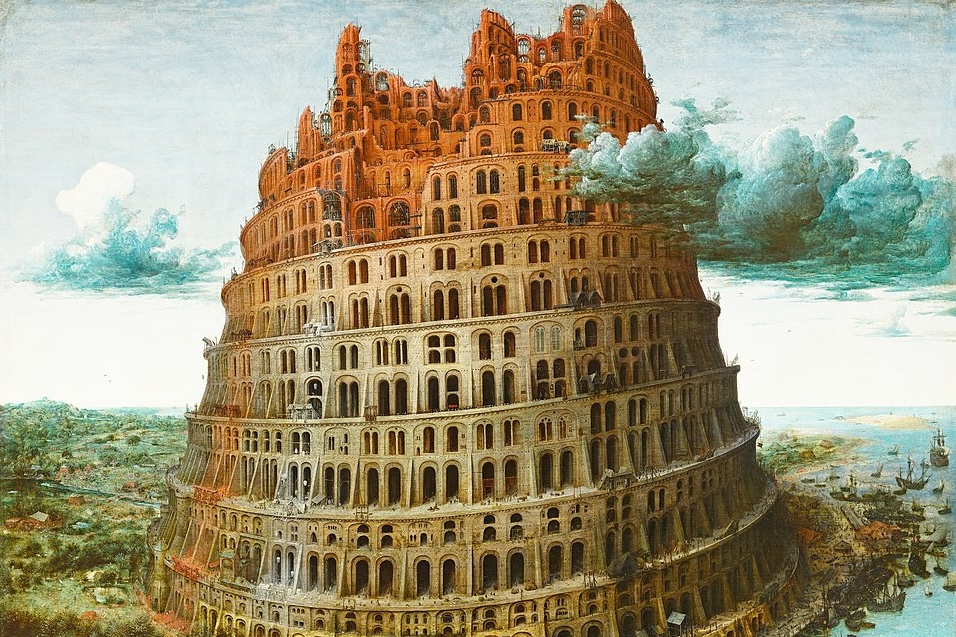
Picture credit: Pieter Brueghel the Elder, “The Tower of Babel” (about 1658). The Museum Boijmans Van Beuningen, Rotterdam.
 World without Borders