“I hope I need not warn you against Montalembert’s declamation about Poland—He has no idea about the insanity of nationality….”
Acton to Richard Simpson (25 September 1861)
The sixty-year period culminating in the First World War witnessed a momentous transformation in the European state system. Italian and German unification, the expulsion of the Ottomans from southeastern Europe, the destruction of the three remaining empires—the Austrian, German, and Russian—as casualties of the war, their replacement by a band of successor states stretching from the Baltic to the Balkans: these developments altered completely the face of Europe, as dynastic states gave way to nation-states. Looking back on this transformation once the war was over, many Europeans believed the decision to rebuild their continent on the basis of nation-states made perfect sense. To establish the principles of self-determination and democracy would contribute to peace and prosperity by solving the nationalities problem that had caused such mischief in the past. But in the 1860s, as this transformation was just beginning, the question looked very different, especially to the young John Dalberg Acton—the future Lord Acton, famous for the Cambridge Modern History—as he contemplated without benefit of hindsight the rise of the modern nation-state.
1
Acton developed his thoughts on the nation-state in an article on “Nationality” that he wrote in 1862 for the Home and Foreign Review. The idea that Europe should be rearranged according to the principle of nationality was, he acknowledged, a “new question in political philosophy,” and his essay was a remarkably precocious treatment of the subject. In this tour de force, Acton placed nationalism in its historical context, encouraging readers to recognize it as the most potent force unleashed by the French Revolution. For Acton, the Revolution had given a new direction to popular protest. In the past, he explained, people had resisted oppression by calling for a return to traditional ways, but now they demanded a new social and political order. The Revolution thus generated protest movements of a wholly unprecedented kind. These movements were “spontaneous and aggressive,” he warned. They were “popular, unreasoning, and almost irresistible.” They appealed to the masses, encouraging them to be “arbitrary as well as insubordinate” and to disregard tradition, prescription, and established rights. Nationalism, with Mazzini as its leader, was the most formidable of these new mass movements: it subverted the existing order by attacking the territorial arrangement and sovereignty of legitimate states, and it provided the impetus behind contemporary revolution. In contrast to later generations, who may have regarded nation-states as likely to promote peace and prosperity, Acton believed that creating these states by imposing the principle of nationality would destroy the Europe he knew and valued.
Acton clearly appreciated the power of nationalism—and for this he deserves credit—but too much can, and has, been made of his foresight. He was disturbed by nationalism not because he was clairvoyant, not because he saw in nationalism the twentieth century’s totalitarian nightmare, but rather because he was preoccupied with a number of nineteenth-century concerns. When in 1859, Cavour and Louis Napoleon contrived their war against Austria, hoping to drive the Habsburgs from Italy and capture the provinces of Lombardy and Venetia for Piedmont, they exacerbated the nationalities problem in much of southern Europe. In Italy this problem was solved by the creation of a unified nation-state. The war against Austria was the first step in the process of unification that culminated in 1861 with the founding of the Kingdom of Italy. As a result of unification, inhabitants of the Italian peninsula found themselves subject to a highly centralized state, with an administration modeled on the Napoleonic system that was adverse to regional autonomy. The Italian war also aggravated the nationalities problem in the Austrian Empire, though with different results. In particular, Austria’s defeat in the war raised the question of how the Empire should be organized: should it be ruled from Vienna as a unitary state, should it be governed as a federation of autonomous provinces bound together by their allegiance to a common crown, or should it be allowed to fragment into completely independent nation-states? This question was answered, temporarily at least, in 1867 with the establishment of the dual monarchy, an arrangement that granted autonomy to the Hungarian portion of the Empire, but subjected the national minorities in Hungary to a Magyar-dominated administration.
Acton, who had family ties to the southern German and Italian aristocracies, spent many months in 1859, 1860, and 1861 visiting central Europe and studying closely events in Italy and their repercussions for the Habsburg monarchy. These developments provided the context for his “Nationality” essay. On one level, the essay can be read as a response to Italian unification. When Acton wrote that nationalism would subvert the existing order, he had in mind the recent changes that Italian unification had brought to Europe. Borders had been redrawn and legitimate governments deprived of their authority, French influence had increased at the expense of Austrian, the balance of power had been disrupted. These developments provoked Acton because they challenged his religious and political views: as a Catholic, he was afraid that the unification of Italy would deprive the Papacy of its lands, thereby threatening its independence; as a critic of democracy, he feared the new Italian state would exhibit the despotic centralization that he considered endemic to modern democracies. The essay on “Nationality,” then, was Acton’s reaction to Italian unification and a warning against the destructive potential of nation-states born of revolution. On another level, however, the essay can be read as a response to the nationalities problem in the Austrian Empire. Acton rejected equally schemes that would transform the Empire into a unitary state, governed from Vienna by a centralized bureaucracy, as well as schemes that would break it apart into centralized nation-states. Both alternatives he considered oppressive: they would allow majorities to dominate the state and tyrannize minorities. Instead, Acton opted for the middle ground, seeking diversity within unity. As his reporting on Austrian politics makes clear, he looked favorably on arrangements that would preserve the unity of the Empire, but at the same time block excessive centralization by granting self-government to as many diverse nationalities as historically made sense. Acton’s essay, with its organic view of society, its advocacy of self-government and its opposition to democratic centralization, provided a theoretical justification for such a multinational empire.
2
Acton wrote his essay against the backdrop of Italian unification. Events in Italy disturbed him profoundly and they provided the context in which he developed his key ideas. Writing in the contemporary events column of the Rambler in January 1860, as revolution consumed the Romagna and the drive for unification threatened the Papacy, Acton alerted his readers to the dangers facing Europe. Liberalism and revolution, he warned, were marching hand in hand under the banner of nationalism, and their victory would spell the end of real freedom. To make nations independent by granting power to the people would create democracies in which the majority would tyrannize over the minority. “Foreign liberalism,” he wrote, “demands, not freedom, but participation in power. Now power increases according to the number of those who share it. No authority is irresistible, no tyranny boundless and hopeless, but that which is wielded by a majority over a minority. No despotism is more complete than that which is the aim of modern liberals.” Instead of seeking the conditions for freedom, which would entail limiting the power of the state, liberals were ready to grant unlimited power to the sovereign nation. “…The liberal doctrine,” he continued, “subjects the desire of freedom to the desire of power, and the more it demands a share of power, the more it is averse to exemptions from it. This is the aspiration of nations which know not what freedom is. Where the people is sovereign, it wishes to exercise its sovereignty, not to be restrained in the exercise of it.” This conviction, this fear that liberals would sacrifice individual freedom in order to achieve national independence, lay at the heart of Acton’s despair over developments in Italy.
Support for Italian unification was widespread in England at the time Acton was writing. To free Italy of Austrian and papal misgovernment was a popular cause among progressives, and it provided one of the central planks on which Palmerston, Russell, and Gladstone consolidated the Liberal party in 1859. But despite this groundswell of support for the Italians, there were some who viewed unification with misgivings: English and Irish Catholics worried about the implications of unification for the future of the Papacy, conservatives and liberals feared the spread of revolutionary democracy, Victoria and Albert understandably favored Austria, believing that the Habsburg cause stood for legitimacy and was in the best interest of Germany. But above all, the military intervention of France made the entire enterprise suspect. As Louis Napoleon’s forces poured into Italy, some English observers began to fear that history was repeating itself. French participation in the war against Austria seemed to portend a second Napoleonic empire that might easily consume other parts of Europe. Nor did anyone expect a French victory to achieve independence for the Italians since it would merely substitute French domination for Austrian. Acton not only shared his countrymen’s fear of French aggression, but probably took it further than most. For him the Second Empire, in true Bonapartist fashion, was a despotism of the most dangerous kind—a military despotism based on democracy that would pursue glory in order to gratify public opinion. “War,” he explained during the invasion panic of 1860, “is the great instrument by which a power such as this is retained. It is one of the necessities of the position of a ruler of France, and no prince can hesitate to employ the means which are required for his very existence.” Louis Napoleon, Acton predicted, would soon behave true to form: “Nothing can be less inscrutable or more easy to calculate than his policy; nothing more certain than that some day a war with England will suit his interests, and that when that time comes he will not hesitate to declare it.”
But there was more to Acton’s uneasiness than fear of Napoleonic aggression. France seemed to represent all those liberal tendencies that he found so disturbing. He believed that democracies would always end in despotism, and this conviction informed his interpretation of what had happened in France when Louis Napoleon, the popularly elected president of the Second Republic, had staged his coup and established the Second Empire. For Acton, Louis Napoleon was the embodiment of the general will, centralizing the state and using its power to curtail civil liberties and suppress those minorities that sought, in the name of freedom, to oppose him. Nor was his assessment of the Second Empire far from the mark, since the regime defined itself as a combination of democracy and absolutism, as a Napoleonic dictatorship in which the emperor’s right to represent the nation rested on the consent of the people. Acton was also convinced that France still labored under the influence of its revolutionary tradition. Seen in this light, Louis Napoleon appeared as the culmination of those processes unleashed in 1789—the “revolution on the throne,” Acton once called him—and the Second Empire became a revolutionary force, disrupting European affairs in 1859 just as France had disrupted them in 1789 and 1799. As Acton despondently watched Louis Napoleon champion Italian nationalism and dispatch troops to Italy, he anticipated with foreboding the spread of revolution and everything it entailed: democracy, centralization, and despotism.
These worries all reflected Acton’s hatred of the French Revolution, which he blamed for the failings of modern liberalism. By introducing democratic ideas into contemporary Europe, the revolutionaries had served as a misguided inspiration for future generations. In their pursuit of equality, they had undermined the historic foundation of France, abolishing aristocratic privilege and establishing democracy in its place. The lasting effect of the Revolution, Acton insisted on numerous occasions, was to destroy liberty by delegating power to the people and concentrating further the authority of the state. Behind this critique lay the arguments of Alexis de Tocqueville, whose Democracy in America (1835) had shown how freedom would suffer in a democracy because majorities would dominate, and whose Old Regime and the French Revolution (1856) had emphasized the Revolution’s centralizing tendencies. For Acton the latter work was crucial. It had taught him that the process of state centralization was a legacy of the ancien régime, which the Revolution had completed when it destroyed the autonomy of the aristocracy—the one institution capable of restraining the state—and established a democracy. “Tocqueville has shown,” Acton wrote, acknowledging his debt, “that the French Revolution, far from reversing the political spirit of the old State, only carried out the same principles with intenser energy. The State, which was absolute before, became still more absolute, and the organs of the popular will became more efficient agents for the exercise of arbitrary power.”
With the revolution, now in its Napoleonic phase, enthroned in France and flexing its muscles, Acton expected the worst wherever its influence was felt: the betrayal of liberty and the destruction of the Vienna system, the very mechanism put in place to contain just such a revolution. Because Louis Napoleon was an outsider to the traditional ruling order, France had once again become a dangerous force in European affairs. As heir to the Bonapartist legacy, the French emperor naturally wanted to overturn the state system built on his uncle’s defeat. “Louis Napoleon,” Acton wrote, “elevated to the imperial throne by the suffrages of the whole French population, and in the teeth of the Congress of Vienna, could not really take his place among the old monarchical families of Europe, and be a partner to their treaties. His position was necessarily antagonistic to them from the first.… He was one whose very tenure of power was an infraction of the treaties of Vienna, and whose recognition was both a precedent and an instrument of their abrogation.” Nationalism, in his hands, became a force capable of dismantling the European state system, readjusting boundaries, depriving legitimate rulers of their sovereignty and extending the influence of France.
The corollary of Acton’s animosity toward France was his allegiance to Austria, which remained steady throughout the early years of Italian unification even though he recognized it as something of a lost cause. “I remember you once said,” he wrote to his colleague Richard Simpson in 1859, “alluding to my Austricism, that it won’t do to stick to a sinking ship. I am afraid I am a partisan of sinking ships….” Writing to John Henry Newman at about the same time, he criticized Newman for supporting France in the struggle over Italy and made plain his own his endorsement of the Austrian side: “I have done all in my power, in vain, to discover a flaw in the Austrian case, or any moral justification of the Italian war. I am afraid you will think me extremely Austrian.” Even though Austria did not always live up to Acton’s expectations, its pull remained strong and constant. A year after the Kingdom of Italy had been proclaimed and the process of unification all but completed, Acton could still point to Austria as the “only continental state with which I have any sympathy.”
Acton was drawn to Austria in part because it was still a genuinely monarchical and aristocratic country, whereas post-revolutionary France was not. But Acton took the position further, regarding Austria as one of the few continental states where liberty, as he defined it, could still be found. For a society to be free, he argued, power must be spread among a number of corporations, each of which must exercise authority in its proper sphere without the state interfering. Austria was free because the two most important of these corporations, the aristocracy and the Catholic Church, still enjoyed considerable autonomy within the empire. “Now the only real political noblesse on the continent,” he explained to Simpson, “is the Austrian…. In as much as aristocracy is the framework of liberty, sincere friends of liberty must have the same sympathy with Austria.” Acton made a similar case for the importance of the Catholic Church as a guarantor of freedom. The Concordat of 1850 had restored independence to the Austrian Church by permitting it to manage its own affairs, discipline its clergy according to canon law, make its own appointments and communicate freely with the Vatican. For Acton, these concessions were immensely important since they affirmed within Austria the notion that state power should be curtailed while local authorities, both ecclesiastical and municipal, should enjoy considerable autonomy. Embodied in the Concordat, then, was the principle that defined Acton’s conception of freedom: “…the principle of self-government; the notion that the power of the state is limited to certain definite functions; that all that lies beyond its immediate sphere is subject to different local authorities…. The Concordat bestowed no privileges on the Catholic Church, but gave her freedom by acknowledging the limits to the authority of the state.” Acton set great store by this Concordat: together with an independent aristocracy, it would preserve in Austria the conditions for freedom, while helping to reverse the trend toward absolutism that had started during the reign of Joseph II.
For Acton, the contrast between France and Austria could not be starker. Both had endured absolutism in the past—France under the Bourbons, Austria under Joseph II—but they had responded differently: whereas the French Revolution had accelerated the centralizing tendencies of the ancien régime, undermining the aristocracy and laying the groundwork for the democratic absolutism of the Second Empire, Austria had preserved the autonomy of its self-governing corporations; and whereas France was now spreading revolution across Europe, Austria was the only continental power resisting its progress. Together, France and Austria provided the ideological poles around which Acton interpreted the drama unfolding in Italy. Seen within this framework, Piedmont-Sardinia, now led by Cavour and Victor Emanuel, became the revolutionary force on the Italian peninsula, and the Papal States became the power opposing the spread of revolution. A victory for Italian nationalism—for unification, that is, under the dominion of Piedmont—would mean a victory for modern liberalism, with its centralized state and sovereign general will. It would also mean the defeat of the Papacy, the secularization of religion, and the destruction of the Church as an independent corporation capable of restraining the state.
Piedmont, Acton was convinced, had fallen so far under the influence of France that it had become little more than a French proxy. The revolution, he wrote, “reigns, under different disguises, at Paris as well as Turin,” and Cavour in particular had assumed its deleterious legacy: “Like most of the continental liberals…, he considered the State as endowed with indefinite power, and individual rights as subject to its supreme authority; whilst, like the revolutionists in France, he accepted the legacy of absolutism left by the old régime, and sought to preserve its force under contrary forms.” The tendency of Cavour’s French-style liberalism was to enhance state authority while undermining the independence of the aristocracy and the Church. In Piedmont, as in France, the elimination of primogeniture and a hereditary upper chamber had dealt a blow to the aristocracy. Like his French predecessors, Cavour had taken his vengeance on the Church, confiscating its property and making the clergy financially dependent on the state. The effect of this policy was to subordinate the Church to the secular government, rendering it an instrument for state power rather than preserving it as a barrier to that power. No wonder, Acton declared, the Piedmontese clergy had turned for support to Austria, where the Concordat had guaranteed the Church a genuine independence. No wonder Cavour, in his effort to subdue the Church, had waged his war against Austria.
Cavour’s greatest misdeed was the war against Austria. It was a “flagrant crime,” Acton wrote, a crime that had “menaced every throne and every right in Europe” by setting a dangerous precedent: the revolution could now violate international treaties, deprive legitimate governments of their possessions, and get away with it. The war was also an act of aggression for which there was no excuse other than the plea of nationality. In an assessment of Cavour’s statecraft, written for the Rambler in 1861, Acton readily acknowledged that the Habsburgs had been responsible for much of the misgovernment plaguing the Italian peninsula before 1848, and that Austrian abuses had provided the justification for the revolutions of 1848 and the war against Austria resulting from them. But the war of 1859, he went on, was a different matter altogether. In the decade since 1848, Austria had been reformed and misgovernment was no longer the real issue. Italy, it was true, had not participated in these reforms and much of the peninsula was still miserably governed. But for this, Acton maintained, the Italians had only themselves to blame. Had improved government been their real objective, they would have welcomed Austrian reforms. But since their goal was national independence, they had refused all concessions, fearing that acceptance would undermine the nationalist cause by improving relations with Austria.
But Acton raised even greater objections to Piedmont’s war against Austria than these, objections that got to the heart of his quarrel with nationalism—its assault on Catholic Europe. The invasion of Lombardy, he claimed, was simply the first step in a much larger plan to destroy the Catholic Church. With the acquisition of Lombardy assured, Piedmont had turned against the Papal States, inciting an insurrection in the Romagna which Acton termed the “crowning achievement of Piedmontese policy.” This assault on the Papacy was hardly surprising, for in pursuing it, Piedmont was behaving in a manner consistent with the revolution’s anticlerical character. An attack on the Church had been fundamental to the French Revolution and it had remained an important goal of the revolutionary movement ever since. Throughout the early nineteenth century, the Church had formed one of the principal barriers against the centralizing tendencies of the liberal state. In its attempt to render the state omnipotent, therefore, the revolution needed to subdue the Church and bring it under control: “The destruction of the [pope’s] temporal power,” Acton warned, was “…the necessary conclusion of a work of which the confiscation of the property and the rights of the Church in each Catholic country was the necessary preliminary.”
Acton emerged from the start as a defender of the pope’s temporal power. It was, he said, one of his “sinking ships.” He readily acknowledged that temporal power was not essential to the Church’s spiritual mission, and he could even envision a time, albeit in the distant future, when the Church would be able to relinquish safely its temporalities. But given the current state of affairs, given the animosity of liberal states to self-governing corporations, the temporal power was a necessary defense: “It is her protection against the State, and a monument of her imperfect victory over the ideas of the outer world. It is not so much an advantage as a necessity, not so much desirable as inevitable. It is required, in order to save her from the political designs and combinations of a system in whose name she is now required to surrender it.” Acton also defended the pope’s temporal power on general political principles—the rights, that is, of property and sovereignty. In an article on “The States of the Church,” written for the Rambler early in 1860, he sketched the history of the Papal States, demonstrating that the popes had acquired their lands in the same way and exercised their sovereignty for the same reasons as every other European prince. To deny the pope his temporalities would thus be tantamount to undermining the rights of every sovereign—indeed, of every property holder—for what the revolution could take from one, it could just as easily take from another. Finally, Acton defended the temporal power for what it was: an ecclesiastical government. He was the first to admit that an administration by priests was something of an anachronism in the nineteenth century and that the Papal States were badly governed. But the remedy for this maladministration was not to impose on the States modern notions of secular government, which was what the French had been trying to do ever since they had occupied Rome in 1848. Rather, he insisted, good government would return to the Papal States when, and only when, their administration was purged of modern accretions and allowed to follow its own traditions.
By the time he wrote his essay on “Nationality,” Acton considered the temporal power all but lost. The defeat of the pope’s armies at Castelfidardo in September 1860, the collapse of the last Bourbon stronghold at Gaeta three months later, Cavour’s declaration that Italy must have Rome as its capital, and Louis Napoleon’s reluctance to stand in the way of unification made it only a matter of time before Piedmont would consume the papal domains. In this unfortunate situation, Acton saw only two alternatives: either the pope could make his peace with Piedmont, which would spell disaster since it would surrender the Church to the revolution, or else he could flee. Acton advocated flight: “Rather than trust to Piedmont,” he counseled in November 1861, “may Pius IX remember the example of his greatest predecessors, who, relying on the spiritual might of the Papacy, sought beyond the Alps the freedom which Italy denied to them.”
As he contemplated the imminent collapse of the pope’s temporal power, Acton offered some of his deepest reflections on the incompatibility of revolutionary nationalism and Catholicism. The publication of Ignaz von Döllinger’s Kirche und Kirchen (1861) provided the occasion. Reviewing his mentor’s book in the Rambler, Acton argued that Catholicism, because of its universalist claims, was simply antithetical to nationalism. The essence of Christendom was to unite nations in harmony rather than to divide them as nationalists would when they advocated the establishment of independent nation-states: “…The institution which Christ founded,” Acton wrote,
in order to collect all nations together in one fold under one shepherd, while tolerating and respecting the natural historical distinctions of nations and of States, endeavours to reconcile antagonism, and to smooth away barriers between them, instead of estranging them by artificial differences, and erecting new obstacles to their harmony. The Church can neither submit as a whole to the influence of a particular people, nor impose on one the features or the habits of another; for she is exalted in her catholicity above the differences of race, and above the claims of political power.
Heresy and nationalism were the two great forces undermining this Christian harmony, and it was no coincidence, Acton asserted, that in the past they had always worked together. The Donatists in northern Africa, the Copts of Egypt, the Armenians and the national varieties of Protestantism: these heresies had embodied the aspirations of particular peoples and, like modern nationalism, they had been revolutionary and destructive of order. The Albigenses, Acton declared, were the “Socialists” of their age: “They assailed the fundamental institutions of society, marriage, family, and property, and their triumph would have plunged Europe into the barbarism and license of pagan times. The principles of the Waldenses and the Lollards were likewise incompatible with European civilisation.” In contrast to these national heresies, only Catholicism was truly universal and thus capable of maintaining peace and stability in Europe. Holding up this almost medieval view of a united Christendom as his political ideal, Acton saw an independent pope as its most necessary feature, for only a single leader could prevent the fragmentation of the Church, the triumph of heresy, the victory of the nation-state.
Reading these pronouncements from the late 1850s and early 1860s, it is hard to exaggerate the sense of crisis that Acton felt as he watched developments in Europe. A world he found congenial was disappearing under the pressure of Italian unification. An international system based on dynastic legitimacy and a political order based on Church and aristocracy were yielding to something new and disturbing: the age of the democratic nation-state. The casualties of this transformation, he feared, would be freedom and the independence of the Catholic Church. At the center of these changes, driving them forward, Acton located the principle of nationality—the notion that nations and states should be coterminous. What bothered Acton most about nationalism was its association with democratic revolution. There was nothing particularly disturbing about a heightened awareness of nationality. In the appropriate context, as will become clear, it was even desirable. But when allied with revolution, nationalism became destructive of the conditions necessary for freedom.
3
Amid this crisis, Acton came forward as an opponent of democracy and as a spokesman for an alternative path to liberty. His essay on “Nationality” was part of this larger enterprise. The only way to create a genuinely free society, he told his readers in one essay after another, was to spread authority among a multitude of independent institutions. To do the opposite, to concentrate authority in a democratic state as continental liberals were advocating, would create a government where the will of the majority would tyrannize over all minorities. The problem with democracy was that it made the general will supreme, thereby forcing all other interests to submit to its demands. Traditional rights, previously established liberties, obligations rooted in past practice—all had to defer to the new democracy, which was blind to the claims of history. Any expression of independence, whether on the part of individuals or organizations, was discouraged if it opposed the collective will. In a democracy, Acton warned, the state became absolute and true liberty was impossible.
In answer to these liberal advocates of democracy, Acton envisioned a society where the state was limited because power was spread among a number of authorities. Only when independent corporations exercised control over their respective domains would forces develop that were strong enough to protect minorities from the domination of the state. Granting institutions the right to administer their own affairs without interference, Acton argued, would establish the conditions for liberty because it would guarantee that significant areas of the nation’s life were beyond the reach of the general will. This vision of a free society was rooted in a respect for the medieval past, a time when aristocracies, municipalities and above all the Catholic Church had enjoyed their immunity from the state and exercised authority within their appropriate spheres. As an example of how the autonomy of these institutions promoted liberty, Acton pointed most frequently to the Church. Throughout its early history, the Church had worked hard to preserve its freedom, insisting that religion was a matter of conscience in which the state had no right to interfere. Animated by this sense of independence, it had exerted a salutary influence on the political development of Europe, ensuring that the medieval state would allow other corporations to retain their privileges as well. “A free Church implies a free nation,” Acton wrote, drawing out the implications of his reasoning. “The absolutism of the State recovers all its oppressiveness where the vast domains of religion are not protected from its control by a Church in which there is no room and no excuse for arbitrary power.”
As this emphasis on history suggests, Acton based his political thinking on organic principles. He regarded society as a complex organism that had developed over a long period of time, and he believed that government must grow out of society, adapting to its intricacies. These considerations led him to reject revolutionary solutions to political problems. He found it presumptuous to believe that human design could improve what history had taken years to accomplish. The conditions that made liberty possible could not be created overnight by a band of Jacobins, but were instead the product of slow political growth. The steady action of the Church on the Teutonic state, for instance, which had resulted in the emergence of self-governing corporations, had taken centuries to complete. Here, then, was the essence of Acton’s quarrel with contemporary liberals. Rather than seeking the safeguards for liberty in those institutions, like the aristocracy or Church, that had achieved their place in society after years of development, they had chosen to undo the work of history and disregard its lessons. The consequence of their shortsightedness was the modern democratic state and the tyranny of the majority.
The revolutionary and the organic: these contrasting approaches to political change represented antitheses within Acton’s thought, and to each of them he attached a corresponding variety of nationalism. Revolutionary nationalism, he argued, had emerged as a political force at the end of the eighteenth century, after the partitions of Poland had deprived the Poles of their state and left them demanding its restoration. But it was the French, more than the Poles, who imparted to this nationalism its special characteristic: the idea that a nation could disregard its past and unite in a democracy in order to achieve equality. When the French revolutionaries destroyed the ancien régime and appealed to the people, they did exactly this—they created a democracy without a past. For what had previously given France its identity was the traditional state, the legitimate French monarchy, which had taken ages to shape the country into a nation, and this the revolution destroyed: “The France of history,” Acton wrote, “fell together with the French State, which was the growth of centuries.” The revolutionary regime that replaced this traditional France was democratic, because it comprised the entire French people, and its goal was not liberty, but equality. The French masses hated all forms of privilege and were not afraid to use the power of a centralized state in order to destroy the nobility and achieve equality. By replacing the ancien regime with democracy, the French Revolution gave new meaning to the idea of a nation, transforming it into a manifestation of the popular will that was divorced from the past and intent on the revolutionary pursuit of equality.
Revolutionary nationalism, Acton went on, had become prominent once again following the Restoration. This was particularly true in Italy, where the severity of Metternich’s repressive policies had given new impetus to the revolutionary movement. For Acton, Mazzini epitomized the revolutionary nationalist, the democrat who believed that the state and nation should be one. Mazzini had started out as a solitary figure, a conspirator without a following, but by mid-century, Austrian misgovernment and the triumph of democracy in France had transformed his brand of revolutionary nationalism into a popular movement. Here for Acton was the source of the nationalism that was wreaking havoc on the Italian peninsula, threatening the Papacy, violating international treaties, and disrupting the balance achieved by the Congress of Vienna—and all for what purpose? Simply to create an Italian nation-state that was unprecedented, having no justification in history, and that would take on the worst characteristics of French democracy. To manufacture an Italian nation-state was a revolutionary act because there had never been a historical unity to the Italian peninsula, there had never been an Italian state capable of forging an Italian nation: “The country is in no respect homogenous; the different parts have different traditions, different characters, and have lived under different laws. These are the things which form a nation (not language or descent), and in Italy they have formed distinct and different nations. The nation is the product of the state, not its cause.…”
In contrast to this revolutionary nationalism, Acton posited an alternative—what we might term an “organic” variety of nationalism—which demanded not national unity within a single democratic state, but rather the peaceful and beneficial coexistence of many nations within a larger empire. In these circumstances, the nation would function as a safeguard for liberty because it would act as one corporation among many limiting the power of the state. In a multinational empire, then, nations played the part of self-governing corporations, which for Acton were the necessary preconditions for liberty: “No power can so efficiently resist the tendencies of centralisation, of corruption, and of absolutism, as that community [the nation] which is the vastest that can be included in a state,… and which arrests the action of the sovereign by the influence of a divided patriotism. The presence of different nations under the same sovereignty… promotes independence, by forming definite groups of public opinion, and by affording a great source and centre of political sentiments, and of notions of duty not derived from the sovereign will.” This conception of the nation as a self-governing body within a multinational state deserved the epithet “organic” because it demonstrated a profound respect for the process of historical growth. Rather than bulldozing over all differences in order to create an artificial unity, as revolutionary nationalism demanded, its organic counterpart championed that diversity which was the product of history: the coexistence of distinct nations, each the product of a unique historical development and defined by diverse customs, habits and laws, lay at the heart of its organic vision.
Acton thus rejected the nation-state, which was the product of revolution and antithetical to his conception of freedom, and defended instead multinational empires such as Great Britain or Habsburg Austria. Such polyglot states were not only free, with a plurality of self-governing nations restraining the central government, but they were also “the chief instruments of civilization.” It was intellectual cross-fertilization, conducted by diverse nations existing within a single state, that led to progress and the advance of civilization: “The combination of different nations in one state is as necessary a condition of civilized life as the combination of men in society. Inferior races are raised by living in political union with races intellectually superior. Exhausted and decaying nations are revived by the contact of a younger vitality.” But the fruitful interaction possible among the nationalities within a large empire was apparently impossible between independent nation-states. Because of their homogeneity and isolation from one another, nation-states thus deprived themselves of the benefits of crosscultural exchange and could look forward to stagnation: “Where political and national boundaries coincide, society ceases to advance, and nations relapse into a condition corresponding to that of men who renounce intercourse with their fellowmen.” These considerations led Acton to extol the large empire, the polyglot that made it possible for a number of nations to exist peacefully side by side, each enjoying its autonomy and benefitting from the intellectual contact with its neighbors that would promote an advanced civilization. These considerations also led him with equal urgency to condemn those nation-states that sought to eradicate regional and national differences in the pursuit of a sterile uniformity.
Like its revolutionary counterpart, organic nationalism was a product of the French Revolution. In particular, it developed out of the European resistance to Napoleonic conquest. Almost all the conquered lands saw the rise of popular movements aimed at expelling the French and dismantling the administrative system imposed by Napoleon. What distinguished these national liberation movements was their opposition to both the absolutism of the old order as well as the centralizing tendencies conjured up by the French Revolution. Especially in the German states, nationalists like Stein, Görres, and Humboldt rejected both Bonapartism and absolutism, regarding the autonomy of nations as a necessary barrier against any kind of centralized state. The triumph of organic nationalism, however, was short lived, for these popular movements were pushed aside at the Restoration, which tried to bring back the absolutism of the ancien régime.
Despite the emergence of Mazzini’s revolutionary nationalism in the decades following the Restoration, some champions of an organic nationalism persisted, particularly in the Austrian Empire. Among his own contemporaries, Acton identified the Hungarian writer and politician Jószef Eötvös as a spokesman for this type of nationalism. Eötvös had grown dissatisfied with the revolution of 1848 because of its demand for an independent Hungary, arguing instead for Hungarian autonomy within the Habsburg empire. Acton praised Eötvös’s major work of political philosophy, Der Einfluss der herrschenden Ideen des 19. Jahrhunderts auf den Staat (1851–1854) as “the best existing confutation of the theories of democratic Liberalism, and an excellent defense of the principle of the limitation of authority. Denying the sovereignty of the majority, and the omnipotence of the state, he [Eötvös] establishes authority and liberty on the autonomy of moral individualities. The foremost of these, he argues, is the nation. As liberty is due to every corporation, as well as to every individual, and as the power of the state is limited by private rights, the same respect is due to the rights, liberties and independence of each nationality.”
Acton’s mention of Eötvös in this context is significant, for it suggests the profound influence that Austro-Hungarian politics had on Acton’s own thinking. In the Empire, far more than in England, political debate in the early 1860s was played out between liberals favoring state centralization and conservatives demanding a federalism that would respect the historic rights of the aristocracies and nations making up the Empire. Responding to the revolutions of 1848, Austria’s minister of the interior, Alexander Bach, had overseen the creation of a centralized state aimed at strengthening the position of the emperor. To the extent that Bach’s system used its authority to promote reform, it garnered support from liberals, some of whom came to see its bureaucracy as the best means to modernize Austro-Hungarian society, to break down aristocratic privilege, overcome local particularism and unite the Empire’s various nationalities in a single German-speaking state guaranteeing civil liberties. Bach’s system, however, did not last long. The loss of Italy in 1859 opened a period of constitutional reform designed in part to discourage the Hungarians from taking advantage of Austria’s humiliating defeat by rising in rebellion. The October Diploma, issued in 1860, marked a retreat from Bach’s centralized absolutism by calling for a federal constitution granting wide autonomy to Hungary and the other historic regions of the Empire. Even though its decentralizing tendencies were never thoroughly implemented, the October Diploma sparked a controversy between centralists and federalists that lasted through the compromise of 1867.
Acton’s coverage of these debates in the Rambler demonstrates clearly where his sympathies lay. He opposed, it goes without saying, those parties that he believed would push the Empire toward greater centralization. In this category, he placed the “advanced” liberals, whose advocacy of parliamentary democracy and extensive bureaucratization represented the kind of liberalism that he found most objectionable. He disliked as well the Hungarian “old conservatives.” Appealing to the principle of nationality, these aristocrats hoped to transform the Hungarian side of the Empire into a virtual nation-state, imposing the Magyar language on everyone and denying communities the right to self-government, practices that would allow the Magyars to dominate all others. Acton was more sympathetic to the Czech “Centrifugal party,” seeing in its desire for Bohemian autonomy an obstacle to centralization, and he sympathized as well with the “absolute” conservatives, finding their support for provincial self-government congenial, even though he admitted their nostalgia rendered them politically useless. But Acton reserved his real praise for a small group of conservatives, close to the emperor and led by Count Heinrich Clam-Martinitz. These aristocrats stood for everything Acton had championed. As he described them: they are “the advocates of self-government on the basis of historical tradition, the party of organism and autonomy. They wish each province to preserve its individuality and its rights, and desire to revive every where, as far as possible, the remains of the old representative institutions, modifying them according to the altered condition of the time. They demand full municipal liberties, and accept only so much of centralisation and unity as political necessity requires. They are not, therefore, zealous for an imperial parliament, but hold to the authority of the crown, limiting and fencing it by an improved system of provincial estates.” In short they were, according to Acton, the party of decentralization and self-government.
When Acton’s “Nationality” essay is read in the context of these debates, its relevance to the Austrian situation becomes clear. The very categories of Acton’s argument—organic versus revolutionary change, self-government versus centralization, multinational empires versus nation-states—spoke directly to Austrian affairs. His conviction that self-governing corporations were indispensable to a free society was rooted in the central European tradition of autonomous municipalities. His dislike of revolutionary nationalism served as a rebuke to those advocates of Italian unification or Hungarian independence who would disregard the historic legitimacy of the Habsburg monarchy and divide the Empire into unprecedented nation-states. His endorsement of an organic nationalism justified gathering a number of nations together under one Habsburg sovereignty and granting them their historic privileges—their right, that is, to self-government—as a means of checking the liberal tendency toward democracy and centralization.
The impact of Austrian affairs on Acton’s thinking becomes even more apparent once his analysis of the nationalities question is compared to Eötvös’s treatment of the same subject in his Herrschenden Ideen. Indeed, the similarities between Acton and Eötvös on any number of issues is quite remarkable. Like Acton, Eötvös believed that excessive centralization posed the greatest threat to liberty in Europe, a threat that was most acute in democracies, where unrestricted majority-rule rendered the state absolute. Only by granting autonomy to intermediate bodies like churches, nations or aristocracies, Eötvös warned, could state power be limited and individual liberty secured. Eötvös thus put his trust in the principle of self-government, which he defined in true Actonian fashion as the “stable and effective organization of local communities, with the activity of the state confined to what directly concerns it or what only it can do.” The origins of this principle he, like Acton, located in the Christian Middle Ages: Christianity was a religion that demanded freedom from state interference, and the independence of the Church, in both the past and present, became a guarantee that other corporations would retain their independence as well. When he applied these observations to the problem of the nation-state, Eötvös reached the same conclusion as Acton: in an age of democracies, he concluded, the nation-state threatened to undermine true freedom precisely because it gave unrestricted power to the majority, allowing the nationality with the largest population to oppress all others. Instead of favoring the nation-state, Eötvös made a case for the multinational empire in which a number of diverse nationalities were allowed the right to self-government. Once again, his arguments were Actonian: granting autonomy to a number of nations within a single empire would limit state power by establishing large areas in which the government had no right to interfere. The similarities between Acton and Eötvös on all these issues—and they could be drawn in even greater detail—are striking, suggesting that both writers developed their views within a common central European environment.
4
If we define a “liberal” as one who believes in liberty, then Acton deserves the label, and his critique of the nation-state can be understood as an intellectual effort to defend the autonomy of the individual against the emerging juggernaut of the modern democratic state. Nor need Acton’s dislike of democracy pose a problem, given that a profound distrust of democracy shaped so much of Victorian liberal thinking. And yet there are aspects of Acton’s position on the nation-state that sit uncomfortably within the mainstream of nineteenth-century British liberalism: his attraction to aristocracy and the Catholic Church, his defense of legitimacy, his respect for the medieval past—these attest to a conservatism more often found among traditionalists like Edmund Burke, generally regarded as one of the principal ideological sources of Victorian conservatism. Indeed, Acton often spoke of Burke in glowing terms: he was England’s “greatest statesman” and his speeches from the 1790s were “the law and the prophets.” What is more, Acton read Burke as essentially a Catholic thinker: “In the writings of his last years,” Acton explained, referring to Burke’s polemic against the French Revolution, “…whatever was protestant or partial or revolutionary of 1688 in his political views disappeared, and what remained was a purely Catholic view of political principles and of history.” As these observations suggest, Acton valued Burke most of all as a critic of the French Revolution. From him, Acton would have picked up many of the elements that informed his own thinking about politics: his reverence for practices rooted in the past, his abhorrence of revolutionary change, his conviction that democracy was a kind of despotism and that the French Revolution had been fatal to true liberty.
A glance at Acton’s place in mid-Victorian politics reveals a picture no less ambiguous. Between 1859 and 1865, he sat in the House of Commons as a Liberal representative for the Irish borough of Carlow, and yet he never seems to have felt completely at home in the Liberal party. In his political journalism, he warned his readers that neither Liberals nor Tories could be trusted to pursue policies that Catholics would find agreeable. Rather than attach themselves to either party, he continued, Catholics should develop their own political principles. Acton’s writings from the 1850s and 1860s can be read as an attempt to formulate a distinctly Catholic approach to politics and to impress this approach on the Liberals. The issue that disturbed him most, driving the wedge between him and his party, was the decision to endorse Italian unification. Under the leadership of Palmerston, Russell, and Gladstone, the party—or so Acton claimed—was reverting to the radicalism of the 1790s: “democratic reform at home,” he complained, “and democratic revolution abroad.” Believing its Italian policy had allied the party with the worst continental developments, Acton blasted the Liberal leadership: Palmerston’s “constant endeavour at the Foreign Office had been to thwart and injure Austria.” Russell was “well known as the time honoured advocate of those principles of an ordinary and superficial Liberalism which pervade the Continent, and have served in France as the soundest foundation of despotism.” Gladstone was “one of the earliest enthusiasts of Italian independence.… He was the associate of men who in the term ‘patriot’ combine an indistinct fusion of the conspirator and the assassin.”
Read in this context, Acton’s essay on “Nationality” becomes a thinly veiled polemic criticizing the Liberal party’s decision to support Italian unification. Europe was undergoing a profound transformation as democratic nation-states were displacing dynastic empires. For Acton it was a drama as tragic as the 1790s. Even the protagonists were the same: France was the revolutionary, Austria the defender of the old order, Italy the battleground, the Catholic Church the victim. Acton’s purpose was to alert his readers to the dangers confronting them, to shake them out of their complacency. This sense of impending crisis certainly gave his writings an urgency, but it also ran the risk of rendering them opaque to future generations who might not appreciate their context—which is a shame, because he saw some issues quite clearly and offered insights that are still worth pondering. He recognized early on that nationalism was a potentially destructive force, that it had a broad popular appeal, and that when empowered it had a tendency to trample on the rights of minorities. But he also acknowledged that nations were products of history with legitimate rights to self-government. The question then became how to organize them so as to keep their ambitions within bounds. Here the Habsburg monarchy, seen as a collection of autonomous corporate bodies, their rights to self-government balancing one another, suggested a way forward. As we contemplate a future in need of increased international cooperation, Acton’s warnings about the nation-state’s potential for disruption and his appreciation of political structures combining any number of nations is deserving of consideration.
© Timothy Lang | Bainbridge Island, Washington
A footnoted version of this essay can be downloaded here: Insanity of Nationality
An earlier version of this essay appeared as “Lord Acton and the Insanity of Nationality,” Journal of the History of Ideas, 63 (January 2002), 129–149.
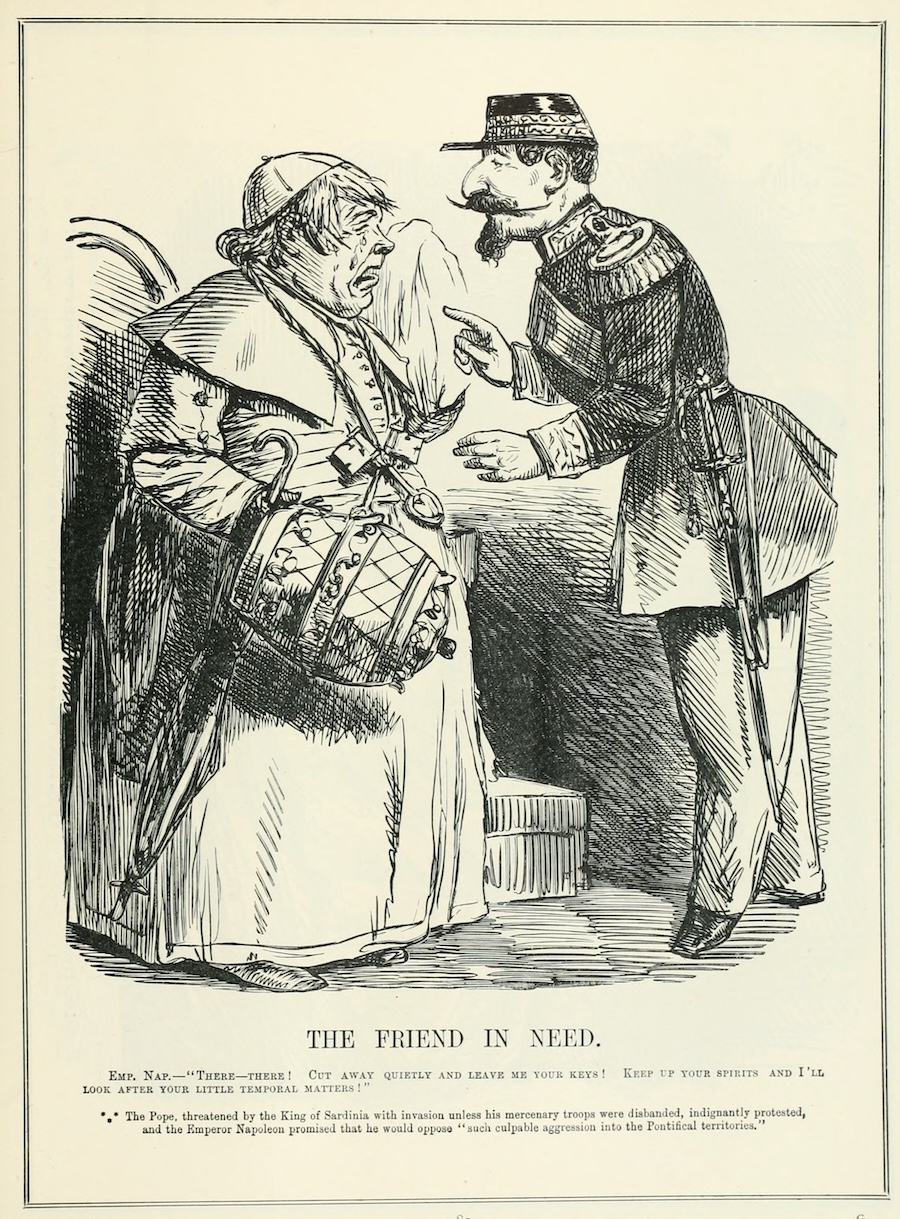
Picture credit: Cartoons from “Punch” (London: Bradbury, Agnew and Co., 1906), 2: 81. Acton often warned that Louis Napoleon, whom he derided as the “revolution on the throne,” was out to despoil the Catholic Church. This cartoon from the English satirical magazine Punch depicts the French emperor as a con man by casting doubt on the sincerity of his intentions to “look after” the pope’s temporalities.

