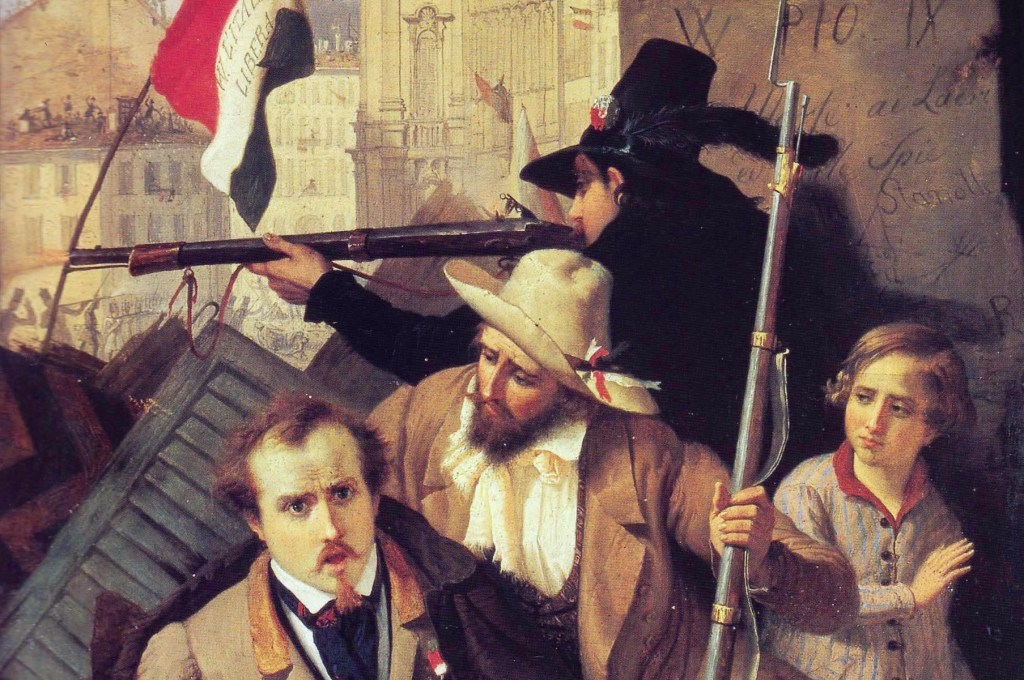
Carlo Cattaneo rarely gave a thought to Italy’s political organization, at least not in his published writings, until his involvement in the Revolutions of 1848 turned his world upside down. A native of Milan and a subject of the Austrian Empire after the Congress of Vienna, Cattaneo (1801–1869) did not begin as a revolutionary. The evidence suggests that before 1848 he was generally content with Habsburg rule, which provided Lombardy with political stability and gave him ample scope to realize his ambitions. By the mid-1830s, he had gained recognition as an important liberal journalist, and with the launching of the Politecnico in 1839, he rose to the top of the profession. With hindsight we can appreciate the role that the Politecnico played in the growth of Italian nationalism—Cattaneo was proud of the contributions Italians had made to European culture, and he used his articles to inform them of their common heritage—but moving Italy toward unification was never his intention. As he said in 1844, in an article on the German economist Friedrich List, the thought that Europe could be reconstructed according to nationality was a utopian dream. The continent he knew was not a neat collection of nation-states, but rather an agglomeration of regions, territorial states of mixed nationality, and multi-national empires.
The revolutions of 1848 finally brought the question of Italy’s future into the open. As Milan rose up against the Austrians, in what became known as the Cinque Giornate, Cattaneo threw his support behind the rebellion and played a critical role in organizing the street fighting. He also made it clear, both to himself and to those who looked to him for leadership, where he thought Italy should be heading. His overriding concern throughout the insurrection was to safeguard the liberty and independence of his native Lombardy. At first he hoped to achieve this within a loose federation of Habsburg nations. But as Milan rose in rebellion and drove the Austrians from the city, any thought of compromising with the Habsburg regime vanished. Nor was he tempted to see Lombardy united with neighboring Piedmont, considering subjection to its Savoyard kings worse than subjection to the Habsburgs, under whose rule Lombardy had at least enjoyed a degree of autonomy. So as most moderates put their faith in Charles Albert and his army, Cattaneo cast his lot with the insurgents, hoping that Lombardy might achieve independence within a federation of Italian republics. As he developed this position over the next decade, he articulated a federal republicanism that was rooted in the Italian past, with its municipal traditions, yet looked forward to the liberal polity he hoped to create: a federation of modern entrepreneurial cities in which citizens promoted the greater good as much by pursuing their individual economic interests as by taking up arms in their defense.
1
Cattaneo appreciated the national dimension to the revolutions of 1848 and from the outset called on the various nationalities comprising the Austrian empire to organize themselves into a league of independent republics according to the Swiss model. The riots that shook Vienna in March, forcing Metternich to flee and the Habsburgs to grant a series of liberal concessions, began a process of dissolution that threatened to pull the empire apart: within days the Hungarian diet declared its autonomy, the Czechs soon demanded national standing equal to the Hungarians, and the minorities within Hungary—Croats, Serbs, Romanians, Slovaks, Ruthenians—insisted on autonomy as the only way to defend themselves against an awakened Magyar nationalism. So long as its future remained uncertain, Cattaneo hoped that the empire might be transformed into some kind of league. His plan called for the creation of seven sovereign states based on the Polish, Bohemian, German, Hungarian, Illyrian, Romanian, and Italian languages. These states would govern themselves according to their own political traditions, a provision holding out the possibility that the Habsburgs might still have a role to play. But Cattaneo’s expectation was that each government would employ republican institutions responsive to the needs of its people. Although he defined these states according to the majority language of their inhabitants, he believed that speakers of minority languages should have equal rights and suggested procedures whereby they could establish their own states in the future. Above all, he would unite these states in a military and commercial league. Each state would enact its own laws, manage its own finances, and field its own army. Each would abide by a strict principle of non-interference in the affairs of other members. But each would also be prepared to defend the others from outside aggression, and would guarantee the free passage of people and goods from one member to another.
Switzerland provided Cattaneo with a model of how the Habsburg lands might be reorganized. In a draft Proclamation found among his papers, he urged the peoples of the Austrian empire to follow the example of the Swiss, who had achieved “friendship and brotherhood” in their struggle for independence. “What they have made in a corner of the Alps, what in five centuries they have not yet completed, you can make following their example with a single, generous, wise revolution, you can make in the vast spaces of the blessed land that God gave you.” The Swiss myth was rhetorically powerful: the free men of Uri, Schwyz, and Nidwalden joining together to defend themselves against Habsburg rapacity, the growth of the league and its eventual independence from the Holy Roman Empire, formalized in the Treaty of Westphalia. The course of Swiss history could be made to show that it was possible for a league of armed republics to resist Austrian despotism while living amicably among themselves. Compelling rhetoric perhaps. But with his vague reference to work still needing to be done, Cattaneo glossed over indications that Swiss brotherhood and friendship were far from perfect: the Sonderbund War of 1847, for instance, when disagreements between liberals and Catholic conservatives degenerated into civil war, or the uncomfortable fact that the French and Italian districts had only recently acquired parity with the older German-speaking cantons. Still, apart from the United States, Switzerland offered the most striking contemporary example of successful federalism. The Switzerland that Cattaneo knew was a league of twenty-two cantons, each a fully sovereign republic, allied together for the purpose of mutual defense. There was no strong central authority before 1848, and no standing army since each canton equipped and trained its own militia. The Confederation was multilingual, with German, French and Italian regions, and to the extent that language defined nationality, it could be regarded as multinational.
Essential to Cattaneo’s republican vision was a preoccupation with language and arms: “Yes,” he wrote in March 1848, “every [people] now has its language, and according to the language it has its flag, it has its militia: woe to the unarmed! It has its militia, but it keeps it within the sacred walls of the fatherland….” Cattaneo’s insistence that borders and languages should correspond was partly an acknowledgement of events—the empire was splitting along linguistic lines—but more importantly it was an acceptance of linguistic uniformity as a necessary precondition for republican government. A prince could dictate to subjects who spoke any number of languages. But a republic called on its citizens to deliberate in a representative assembly, where the need to communicate required mutual understanding, a condition most easily met if everyone spoke the same language. Differences in language, Cattaneo believed, which often revealed deeper differences of interest, would make a republic unworkable, a tower of Babel. Equally important for Cattaneo’s republicanism was the idea of a militia. Republics should be defended by militias not only because a force derived from the people could never be used against the people, but also because a militia, secure in its own homeland, would have no incentive to dominate another nation. The threat to Europe came from the standing armies of princes, whose deployment of foreign soldiers inflamed national hatreds and destroyed the peace. The Austrians dominated the empire precisely because they relied on a professional army drawn from all the subject nations. Their power in Italy, as elsewhere, was based on their ability to garrison the country with German or Polish or Hungarian soldiers, foreigners with little sympathy for a conquered people whose language they did not understand. Returning these soldiers to their homelands would deprive the empire of the means to hold its nationalities in subjection and would contribute to peace and liberty.
Cattaneo was not the first at the time to suggest reorganizing the Habsburg monarchy as a federation based on nationality. Similar ideas were common among central European nationalists in the years leading up to 1848. The Czech historian and politician František Palacký, for example, proposed what has perhaps become the most familiar plan. Like Cattaneo, Palacký took exception to the Germanization of the empire and envisioned a federation in which all nationalities would enjoy complete equality of rights. The international Slav Congress, convened in Prague between May and June 1848 and led by Palacký, recommended reorganizing the monarchy along largely ethnic lines, a federation of nations, equal in rights, with Slavs enjoying the same constitutional position as Germans and Hungarians, all under the Habsburg umbrella. There were other schemes as well, ranging from conservative attempts to work within the empire’s traditional territorial divisions to Mikhail Bakunin’s revolutionary attack on national sovereignty altogether. Despite their obvious differences, Cattaneo, Palacký, and the others were all thinking along similarly federalist lines: proposing federations of one sort or another as solutions to the nationalities problem that was becoming increasingly prominent in the Habsburg lands following the revolutions of 1848. But as Cattaneo noted, looking back from 1851, they had all been premature, with little chance of success.
2
Cattaneo included Italian among the languages which defined his proposed league of central European states, indicating that he fully intended Lombardy and Venetia to secure their independence by joining it. But as 1848 wore on, as Milan rose in open rebellion and the prospect of a Habsburg federation faded, his outlook became increasingly Italian. The revolutions of 1848, it seems fair to say, taught Cattaneo the power of nationalism. Later, looking back over the year, he identified nationalism as the basic fact of the nineteenth century: “God, who destined a thought for each century, committed ours to ensuring that every nation has a land of its own, and to placing the sacred boundaries of its homeland at the point where the sound of its language dies away.” This was particularly true of Italy, where Austria’s domination had roused the Italians to a sense of their own nationality. Here Cattaneo was speaking of his own generation. The Congress of Vienna, he said, had brought the old regimes back to Italy and given Austria the task of defending them. As these governments became oppressive, Italians focused their hatred on the one power that protected all the others—and in their hatred they discovered unity. In the eighteenth century, under Maria Theresa, Austria had been highly decentralized and each of its regions, including Lombardy, had enjoyed considerable autonomy. But beginning with Joseph II, and continuing through the French Revolution and Restoration, the empire had pursued a policy of centralization that gave rise to nationalist opposition throughout its lands. In this context, the Italian revolutions of 1848 became a great national uprising. They were the “most memorable” event in Italian history, Cattaneo declared: “In these glorious days of March and April 1848, for the first and only time, the peoples of Italy, awakened by the cry of a fighting city, all rose up by an unanimous impulse against the same enemy…. This unanimity of the people was without example.”
Cattaneo had always felt a strong sense of italianità, a pride in Italy’s achievements that had come to the surface in many of his essays from the 1830s and 1840s. But this italianità was different from Italian nationalism. Italianità was a cultural awareness, a feeling of belonging to a wider Italian world, of speaking or reading the Italian language, of being alive to Italy’s artistic or literary or scientific achievements, and of its immense contribution to European civilization. Italianità was perfectly compatible with any number of political arrangements. Cattaneo, as an Italian, had been just as comfortable as a subject of the Habsburgs as he would be as a citizen of a Swiss republic. Under both regimes, he could read, think, and write in a thoroughly Italian cultural environment. Nationalism, however, was something different: it was a political position demanding independence, unity of some sort, and self-government. Nationalism thus raised the question of the nation-state: what kind of government should replace the peninsula’s political fragmentation once the Italian states had broken free from foreign domination? Cattaneo’s answer was clear and consistent: only a federation of independent republics would make it possible for Italians to combine liberty with unity. In the years leading up to 1848, he had invariably regarded a consolidated Italian nation-state with skepticism, as neither desirable nor feasible. His goal in 1848 had been to liberate Lombardy and, if possible, the other Italian states, by preventing their absorption into a Savoyard monarchy. In the years following the revolutions, he gained a reputation as one of Italy’s most outspoken federalists.
Cattaneo articulated this vision of a federated Italy in his two historical works, the Insurrezione di Milano and, most importantly, the Archivio triennale. In these books, he urged Italy to unite as a federation of independent republics based on the nation’s historic municipalities. Each republic “must remain free and sovereign.” Each must have its own territory, its own government, its own militia. A national congress, with member states enjoying equal representation, would deliberate on matters affecting the entire federation—finances, foreign policy, defense—and would select a chief magistrate responsible for conducting the inevitable war against Austria. The majority of states, working together in the congress, would guarantee that no one member encroached on the independence of another, and would prevent outside powers from meddling in Italian affairs. In this way, Italy would achieve a national greatness equal to that of Germany or France or Britain, and it would avoid the excessive centralization that plagued French prefectural government, “which at the stroke of a telegraph knows how to maneuver 86 little theaters of 400 thousand marionettes each.” Only a federation would overcome the rivalries, ambitions and jealousies of the individual Italian states, and only a federation would guarantee their lasting independence. At times Cattaneo referred to this as the American model, but more accurately it was an adaptation of the Swiss model that he had applied earlier to the Austrian empire: a league of small republics brought together for mutual protection.
Cattaneo was not alone in advocating federation as the best way to organize Italy once it had achieved independence. Most moderates, at one time or another, had favored a federal solution of some sort, given the political, geographic, linguistic, and cultural divisions that had plagued the peninsula throughout its history. Mazzini, with his vision of Italy as a consolidated nation-state, was in fact the exception. Consider Vincenzo Gioberti, whose Del primato morale e civile degli italiani (1843) vigorously argued the federalist case. A unitary state, he claimed, would never thrive in Italian soil because it was an alien notion, derived from revolutionary France, whereas a federation coincided perfectly with Italian history and conditions. An Italian federation, he argued, should be monarchic and aristocratic, based on Italy’s existing principalities, with the pope at its head. Such a federation would achieve great things for Italy: it “…would increase the strength and power of the various princes, without harming their independence…. It would remove the causes of discord, of wars, of internal revolutions, and would pose an insuperable obstacle to foreign invasions…. It would return ancient honor to the peninsula, placing it among the powers of the first rank….” Cesare Balbo, in his Delle Speranze d’Italia (1844), echoed Gioberti: only a federation would overcome the peninsula’s divisions and build on its commonalities—race, language, customs, history—in order to unite the Italian people. Massimo d’Azeglio’s Proposta d’un programma per l’opinione nazionale italiana (1847) said much the same, calling for unity among the Italian princes.
Cattaneo might have been working within this federalist mainstream, but he was doing so with different intentions. In opposition to moderates like Gioberti or Balbo, Cattaneo rejected a federation of principalities on the grounds that Italy’s princes would never be capable of liberating the country, and that they would undermine its peace and stability should it ever gain independence. Instead, he argued for a federation of republics, even of small republics, of republichette in fact. Mazzinians and moderates had often attacked the idea, insisting that a league of small republics would be fragmentary and weak. But Cattaneo fired back, quoting with emphasis his beloved Bentham: “a diminutive is not a reason.” Just because something was small did not mean it was inferior. The twenty-two Swiss cantons might have been republichette, but when leagued together they were perfectly capable of defending themselves. Military strength, he pointed out, did not depend on the number of men under arms, but rather on their will to fight, which he considered the most important determinant of power. This will flourished whenever those who commanded and those who obeyed were motivated by the same interests, when officers and men were fighting for the same cause. This uniformity of interests he considered the chief characteristic of a republic. Neither the king of Naples nor the pope, nor any other Italian prince for that matter, shared the same concerns as their subjects, which was the source of their weakness and the reason why in 1848–1849 they had failed to liberate Italy. To suggest, as Gioberti had in the Primato, that the kingdom of Piedmont–Sardinia or the Papacy were best placed to liberate Italy was therefore patently false. The country’s future, for Cattaneo, lay with a federation of republics where the common interests of citizens and leaders would guarantee a favorable outcome.
Cattaneo further argued against a federation of principalities on the grounds that it would actually threaten the internal peace and stability of Italy. The peninsula, he pointed out, was already divided into four great subgroups: the Bourbon, Austrian, Sardinian, and Papal. “These groupings are all enemies among themselves: the first three, because they aspire to enlarge themselves at the expense of the others: the last, because it knows how to be seduced by the others. So they all have interests to go to war with each other, and they enjoy amply the misfortunes and dishonors of the others.…” Because the Bourbon, Habsburg and Savoyard princes were all foreigners, their interests were not with Italy, but with their dynasties. Their reasons for joining a federation of principalities would not be to provide peace and stability to the peninsula, but to expand their own territory at the expense of the others. Italian history furnished numerous examples of foreign princes turning Italy into a battleground for their own advantage. The beauty of a federation of municipalities, however, was that its members would all be Italian, with Italian interests, leagued together for the sole purpose of achieving the best for the nation. Because their interests were similar, they would have no reason to impose upon their neighbors; and because they were small, they would not have the means to do so. Italy, he concluded, would have nothing to fear if the republics were as small as in Switzerland: “And therefore—thanks to God, our language does not have only diminutives—we will say that the less grand and less ambitious the little republics [republichette], the more firm and strong will be the big republic [republicone], should it be as vast, not only as Italy, but as the immense America.”
3
Cattaneo continued to promote his vision of Italy as a federation of municipalities throughout the 1850s, right up to the second war of independence in 1859. As he wrote to Giuseppe Ferrari in August 1851, “…the phrase États Unis de l’Italie is equivalent to a public signature for me, being a notorious point of my political faith.” In his correspondence with fellow republicans, he never missed an opportunity to extol the virtues of the Swiss and American systems. “I hear with pleasure that you are studying on purpose American institutions,” he wrote to Enrico Cernuschi in August 1851. “United States is a great term that can solve many problems in Italy and in all Europe; and can prevent a hundred thousand controversies. How different it might have been if Kossuth, instead of proclaiming the ambitious republic of the Magyars, had proclaimed the United States of the Danube; how much less the hatred and opposition in Serbia, in Croatia, in Transylvania; what a happy compromise for transforming… the Austrian empire into a giant and invincible Switzerland.” Five years later, writing to Mauro Macchi in December 1856, he was still at it: “When the Mazzinians shout hurray for unity, it is necessary to reply hurray for the United States of Italy. In this formula, the only one that is compatible with liberty and Italy, there is theory and practice: all possible questions are there already solved with one gigantic example, of which Switzerland offers the compendium for internal use for any Italian province that wants to have within peace and liberty.”
What rankled Cattaneo most was the charge leveled by his opponents that a federation of republics would be inevitably weak. Mazzini even went so far as to claim that Italy had fought the war against Austria as a federation and had failed. Cattaneo vehemently disagreed: “How come serious men have dared to write that the war of 1848 was a federal war?” he complained to Ludovico Frapolli. “Among all those who then commanded the armies, who signed this federal pact? And when? And where? And on what terms? And not even among peoples, not even between free Rome and Venice, between free Rome and Sicily was a federal pact ever entered into, nor was a common congress convened, nor was any solemn promise made to fight one for all, and all for one, as the good federal right requires.” Had the war actually been fought as a federal war, he predicted to Ferrari, had the republics in Venice, Rome, and Palermo entered into a federal pact and “sworn to continue the war fraternally,” then “twenty million people would have carried on the battle” and the outcome would have been very different. As Switzerland had demonstrated, the great strength of a republic was its ability to field an army of citizens. “You have seen the repubblichetta of the Vaud,” he wrote to Macchi in 1856, “which at the request for nine battalions responded by offering twenty-five! …And the Vaud has only two hundred thousand souls; a little more than the province of Pavia. At that rate the republics of Italy would be able to supply more than three thousand battalions!”
In the decade after 1848, with republican and federalist concerns like these very much on his mind, Cattaneo wrote several essays that enable us to connect his ideas about Italy’s future to other aspects of his thinking. In 1854, he reviewed Augustin Thierry’s Essai sur l’histoire de la formation et des progrès du Tiers État (1853) for the Crepuscolo, a Milanese journal of moderately liberal tendencies. Cattaneo was impressed by the French historian’s book, especially by the skill with which Thierry had fastened onto one theme, the rise of the third estate, and used it to make sense of a huge swath of history without ever violating the facts. Several years later, in 1858, Cattaneo attempted something similar. In an essay on “La città,” also published in the Crepuscolo, he identified the rise of the city as “the sole principle according to which thirty centuries of Italian history can be reduced to a clear and continuous exposition. Without this ideal thread, memory would lose itself in the labyrinth of conquests, of factions, of civil wars, and in the assiduous composition and decomposition of states.”
In choosing to focus on the development of the Italian city as a self-governing polity, Cattaneo placed himself in a tradition of historical thinking that stretched from Machiavelli through Sismondi. It was Machiavelli who had taught in the Discourses that cities were best governed as republics, that these republics should command their own armies, and that a league of republics would prove stronger than a league of principalities. But more to the point, it was Sismondi, in his Histoire des républiques italiennes (1807–1818), who had located the seeds of Italian nationality in the cities that had emerged in the Middle Ages as republics. The Italian cities had given to Europe everything that was modern: “the medical science of Salerno, the jurisprudence of Bologna, the theology of Rome, the philosophy, poetry and fine arts of Florence….” For five hundred years these Italian republics had flourished before French, Spanish, and German invaders finally put an end to their independence. With his history, Sismondi provided Italy with a usable past just as the Whig historians had done for England when they invoked the rude liberties of the Anglo-Saxons, located freedom of thought in the Protestant right to private judgment, or upheld the claims of Parliament against the Stuarts.
Cattaneo agreed with Sismondi that Italy’s cities had witnessed the birth of the modern world, and he would echo the sentiment in the course of his essay, but he had other, more germane objectives as well. By stressing the centrality of the city to Italy’s development, he provided his federalism with an essential historical foundation: a nation of independent cities would possess strong traditions of local autonomy that could only be satisfied in a federal arrangement. Unlike France, where a powerful monarchy, joining forces with the bourgeoisie, had defeated the aristocracy and unified the country, Italy had remained fragmented. Ancient Rome, to be sure, had momentarily created an Italian nation as it imposed its armies and language on the previously independent cities of the peninsula, depriving them of their sovereignty and arms. But when Caracalla extended Roman citizenship to all inhabitants of the empire, regardless of their national origins, he deprived his Italian subjects of any sense of national uniqueness. During the Middle Ages, Italy became a battlefield between the papacy and Holy Roman empire, neither of which was strong enough, nor Italian enough, to provide a center around which national forces could unite. Finally, in the sixteenth century, Italy fell to one European invader after another. Cattaneo’s conclusion was clear: because of their singular history, Italians never developed a strong sense of nationality, and as a result their loyalties remained local, focused on the municipalities that had provided them with the one historical constant they had ever known. Even in his own day, Cattaneo observed, the city formed the basic political building block that any Italian nation must take into account. “According to immemorial tradition,” he pointed out, “the people of the countryside… still take the name of their city….” The municipality “is the only fatherland the vulgar know and feel. Our people, in domestic and spontaneous usage, never gave themselves the geographical and historical name of Lombard; they never adopted familiarly these variable administrative divisions of departments and provinces, that transcend the ancient municipal limits. The shepherd of the Val Camonica, a member of now one and now another division, remained always Bresciano. The shepherd of the Val Sassina gives himself always the name of a far away city that he has never seen, and calls Bergamasco the shepherd of the neighboring alp, whereas no farmer calls himself Parisian, not even when almost in sight of Paris.”
Cities, Cattaneo argued, also provided the settings for Italy’s great cultural and scientific achievements, for those contributions to European civilization that gave him such satisfaction and nourished his Italian pride. So, for example, after the barbarian invasions, when the Goths and Lombards adhered to the Arian form of Christianity, the cities retained the Latin ritual and served as the source from which the Latin language eventually spread to the rest of Italy. What would have happened, Cattaneo asked, if the cities had not preserved Latin? Gothic would have corrupted the spoken language, and Italy would have lost touch with the ancient sources of its culture. But more important, it was in the revived cities of the Middle Ages, in the self-governing communes of northern Italy, that a distinct Italian culture burst forth and made its mark on European civilization. For a liberal like Cattaneo, who stressed the importance of science and free enterprise for progress, the Italian contribution to western civilization was appropriately pragmatic. The rebirth of the cities brought prosperity to the countryside, and together the urban and rural economies generated more wealth than Europe had seen before. Roman law revived, feudal tenures decayed, and the right to buy and sell property encouraged economic growth. Italian entrepreneurs cleared forests, drained swamps, built roads, and irrigated plains. The Tuscan cities brought this civilization to perfection as a true “scientific culture” flourished in Florence and spread to the rest of the world. Galileo’s telescope, Torricelli’s barometer, Machiavelli’s empirical politics—these were the products of Tuscany’s practical and restless spirit. “The Tuscan artist did not confine his genius to one art only,” Cattaneo explained. “Leonardo and Michelangelo were painters, sculptors, architects, geometers, physicists, even poets, even philosophers,” and the breadth of their interests, their fascination with facts, with lived experience, led them to embrace the “experimental method.”
Italy’s cities owed their dynamism and creativity to their freedoms. They prospered when allowed to govern and defend themselves, and they fell into lethargy and barbarism when conquered by others. The earliest Italian cities were “autonomous,” and they were armed and organized in federations. But in time, they lost their independence as the Roman empire expanded and bound them within an administrative straightjacket that came to resemble an Asiatic despotism. “The important point was,” Cattaneo maintained, “that [under the empire] Italy was no longer administered through its municipalities…, but through vast prefectures, entrusted to favorites after the fashion of the Persian satraps. So absolute became the authority of these prefects, that in some provinces of the orient they came to take openly the name of despots…. This was for Italian civilization a profound subversion. With Diocletian seven centuries of barbarity were initiated, until the resurgence of the municipalities, around the year one thousand.” To compare the condition of Italy’s cities under the empire with the cities of Asia was telling, for in Cattaneo’s Eurocentric worldview, Asia suggested sloth, pleasure-seeking, and decadence. Asian cities were certainly opulent, Cattaneo admitted, but they were also barbaric: they lacked order, rights, and dignity—and they lacked the dynamism that came from independence. Asian cities were “inanimate, inorganic beings, not able to exercise an act of reason or will upon themselves, but rather resigned to the dictates of fatalism.” Their fatalism, he added, was “not a child of religion, but of politics.”
In contrast to Asian cities, Italian cities, when allowed to develop freely, took the form of corporate bodies, of “political persons” capable of exercising a collective will, and the spirit they embodied was that of the entrepreneurial middle class. The rise of that middle class provided the subject of Thierry’s Histoire du Tiers État, which Cattaneo had reviewed earlier in the decade, and which might very well have prompted his own reflections on the city. According to Cattaneo, Thierry had demonstrated that after the Germanic invasions, municipal traditions had survived in the memories of the native populations that were drawn to the cities, where “they took refuge with the sciences and letters, with what remained of the arts and industry, and where every spark of independence was not at all extinguished.” When the cities revived in the early eleventh century, these “timid shopkeepers were transformed into a fiery bourgeoisie.” From that moment onward, until the outbreak of the Revolution, the French monarchy and that “fiery bourgeoisie” worked together to curb the power of the feudal lords. Kings protected the rights and freedoms of the cities, and in turn the bourgeoisie brought order and economy to the state, laid the foundations for modern jurisprudence, advocated the abolition of serfdom, and encouraged commerce and industry. “…Such was the work of the third estate,” Cattaneo concluded, “…that one can say that all the great ordinances that promoted civilization in France were due to its fruitful initiative.”
Cattaneo then turned his attention to Italy: “It was in Italy in fact that the barbarians left the most fleeting traces of the conquest, it was in Italy that feudalism put down less profound roots, and from Italy came the impulse for that heroic communal revolution, from which the modern world had its origin. Italy can thus call itself the cradle of the bourgeoisie….” In another essay from this period, “Agricultura inglese paragonata alla nostra,” published in the Crepuscolo in 1857, Cattaneo then examined one of Italy’s great contributions to European civilization: the “high farming” that originated around the cities of the Lombard plain. High farming, Cattaneo explained, was an intensive form of agriculture in which an entrepreneurial class of tenant farmers directed the work of hired laborers. These farmers held their lands on monetary leases of long duration, enabling them to produce what the market demanded and encouraging them to plan for the future by improving their holdings. They valued livestock as a source of manure as well as of labor, and they introduced crop rotations instead of allowing fields to lie fallow. This was the agriculture that Cattaneo had celebrated in his essays from the 1830s and 1840s, and that he now presented as one of Italy’s great offerings to the modern world, deserving a place alongside Britain’s development of the railway and America’s introduction of steam navigation. Arthur Young, touring Italy in the 1790s, had studied Lombardy’s agriculture and brought his insights back to East Anglia, where he laid the foundations of the English agricultural revolution.
This essay on “high farming” is important because it demonstrates that Cattaneo appreciated the city above all as an economic phenomenon, as an instance of political economy. The city served as a center of commercial activity whose reach extended far into the surrounding countryside. “Agriculture emerges from cities,” he said, echoing what he had written years earlier. Capital, accumulated in the city and applied to the land, enabled high farming to flourish. Agriculture did not arise from “natural genius” or “bucolic fancy.” Rather it originated in “the institutions and laws that provide capital and industry with access to the land.” Here was a perfect illustration of his favorite maxim, derived from Bentham, that the production of wealth was only limited by the amount of available capital. For centuries, the city had served as a market for agricultural goods, and from its profits had come the capital that enabled high farming to take shape. What is the source of the farmer’s capital, he asked? “It is the market; it is the sale of produce from the fields to a population that does not contribute to their production; it is the proximity of an industrial and commercial population, required to buy provisions. The more people there are who have to buy, the better it is for those who have to sell.” The relationship between city and countryside was thus reciprocal. A growing urban population meant increased sales at higher prices. “For every pair of arms added to the countryside, twenty mouths were added in nearby ports, in the factories, and in the mines.” Cattaneo’s high farmer thrived within these relations of production and consumption. He was a bourgeois, not a laborer. He was a capitalist, not a rentier. With prosperity he had acquired education, culture, thought, and creativity. He was an independent individual, secure in his property, free to pursue his economic self-interest, which contributed to the well-being of his city, his province, his nation.
When Cattaneo endorsed a “United States of Italy,” when he advocated transforming Italy into a defensive league of small republics, he was imagining the peninsula organized as a federation of these entrepreneurial cities. This vision, though it owed much to Cattaneo’s liberal political economy, can also be located within a European republican tradition, dating back to the Italian Renaissance and focusing on the city as a self-governing polity capable of defending itself with a uniform will. Florentine civic humanism had predicated the republic’s survival on the readiness of its citizens to fulfill their responsibilities and bear arms in its defense. Fifteenth-century Italy had been a land of independent regional states, all potentially in competition with one another. Confronted by rivals, the Florentines had called on citizens to lead virtuous public lives, to meet their civic responsibilities, to sacrifice private ambition for the common good, and to bear arms in defense of the republic. Machiavelli in particular understood the problem as a contest between virtù and fortuna, between the spirit of the republic’s citizens and the blind forces of chance. Service in the militia became for Machiavelli the highest expression of republican virtue, as the citizen-soldier renounced private interests in order to defend the republic and impose order on recalcitrant fortune.
Cattaneo often placed himself in this republican tradition. People who wished to retain their freedoms, he liked to say, must “hold their hands high,” and he attributed the phrase tenervi sopra le mani to Machiavelli. Whether or not the attribution was accurate matters little. The admonition that a free people must remain perpetually vigilant was an unmistakably Machiavellian thought, and remaining vigilant described what Cattaneo believed the citizens of Milan had done in 1848 when they put their immediate concerns aside, manned the barricades at great personal risk and loss, in order to defend their city’s freedoms against its Austrian and Sardinian oppressors. His admiration of the Swiss for their willingness to take up arms in defense of their cantons, and his calls for reorganizing the Habsburg monarchy as a federation of armed republics, each with its militia, each with its flag, can likewise be seen as classically republican in this general Machiavellian sense.
But on a more theoretical level, there were important differences that distinguished Cattaneo’s republicanism from that of his Florentine predecessors. For the classical republican, freedom had meant independence. A free state was a polity that was beholden to no foreign power or prince, that governed itself, legislating and enacting its own laws usually through some form of representative assembly. Similarly, a free individual was someone who was dependent on no other person, who was his own master and not a slave. Cattaneo certainly agreed with both principles—he desired the same kind of independence for both Milan and himself—and he said as much: “I believe that the federal principle, as it applies to States, also applies to individuals,” he wrote to Enrico Cernuschi in 1851. “Everyone must safeguard his personal sovereignty….” Individuals must protect their independence within states, just as states must retain theirs within federations, so as to avoid servitude and acquire virtue: “Subjecting oneself to the dictates of others is for the blind and servile. Yielding is for cheats and swindlers.” But to this classical understanding of freedom, he added a more modern dimension that was missing from the earlier formulation: the freedom to pursue one’s own economic interest wherever it may lead. Although a classical republican might object that such a flagrant pursuit of personal wealth was lacking in virtue, a liberal like Cattaneo could reply that there was no necessary incompatibility within the capitalist economy between personal gain and the public good. When the high farmer of the Lombard plain perfected his agricultural practices and improved his lands, he may have done so in order to enrich himself. But in the process, he contributed to the prosperity and well-being of his fellow citizens, as well as to the greater glory of Italy, putting it on a par with Great Britain and the United States.
For Machiavelli, the acquisition of greatness had been one of the chief advantages of the republic. As he explained in the Discourses, pursuing the common good had almost always led to national greatness; and whereas principalities were designed to glorify princes, republics were the only form of government that saw maximizing the public good as their main purpose. Achieving greatness for Italy had also been one of Cattaneo’s principal concerns. A desire to celebrate its past accomplishments informed his writing on history, while a determination to unleash its potential for future eminence shaped his thoughts on political and economic organization. When the revolutions of 1848 raised the question of Italy’s destiny, Cattaneo found his answer in the country’s republican past. A consolidated nation-state, he insisted over and over again, would only subject Italy to the Savoyards or the Papacy, whereas a federation of republics would allow it to remain independent and free. A centralized government would only deprive its cities of their autonomy and dampen their initiative, whereas a federation of republics would encourage their entrepreneurial and creative spirits. Cattaneo’s republicanism might have sought legitimacy in the past, but it looked forward to a future of capitalist development, reconciling the republican’s traditional emphasis on civic virtue with the liberal’s endorsement of self-interest.
© Timothy Lang | Bainbridge Island, Washington
A footnoted version of this essay can be downloaded here: United States of Italy
Picture credit: Baldassare Verazzi, “Episodio delle cinque giornate” (1886). Museo del Risorgimento, Milan.
 World without Borders