“And this also has been one of the dark places of the earth.”
Joseph Conrad, Heart of Darkness (1902)
In early 1919, the British journalist Henry Noel Brailsford spent almost four months traveling through central and eastern Europe. His editor at the Herald, George Lansbury, had sent him there in the aftermath of World War I. Brailsford’s assignment: to report on conditions in the defeated nations. Even though the armistice had been signed and fighting on the western front had come to an end, the Allies still maintained their blockade of the Central Powers, inflicting untold hardship on the civilian population. Brailsford’s reporting took him to starving Vienna, to the battlefields along the Russo-Polish frontier, to Béla Kun’s revolutionary Budapest, and finally to Berlin—just in time to witness the German reaction to the Versailles Treaty. What he saw throughout his travels made an indelible impression on him.
At the time of his journey, Brailsford was already a committed internationalist. He had spent the war years thinking about the future peace settlement and was convinced that it should encourage nations to work together for the common good. Governments made wars, but people paid the price. When peace finally came, he reasoned, it should meet the needs of all people, not just governments. It should provide Europeans, regardless of nationality, with stability and security so they could go about their daily lives without undue worry or fear. To the extent that it treated all people equally, it would be a democratic peace. Brailsford knew that arriving at such a settlement would not be easy. It would require an international organization capable of holding governments to account and ensuring that their policies adhered to “international morality” rather than “national patriotism.” But no matter how difficult to achieve, it should be given a chance. An allied victory that refused to endow a league of nations with sufficient authority to enforce a democratic peace would amount to a great wasted opportunity and a betrayal of the soldiers who had sacrificed their lives for the war effort. “If we fail to create the organization of an enduring peace,” he wrote during the final weeks of the Somme offensive, “we have failed in the only aim which could compensate the world for these years of heroism and misery, of endurance and slaughter. The settlement of the war and the creation of the League are not two separate problems. They are a single organic problem.”
What Brailsford experienced as he traveled through central and eastern Europe did not make him an internationalist, but it certainly strengthened his commitment to that ideal. At each stop along his way, he witnessed the human suffering that the war had caused. He investigated the conditions in which people lived, appreciated the hardships they had to endure, and sympathized with their hopes and dreams now that the fighting was over. He also became painfully aware that the peace settlement, as the statesmen in Paris were arranging it, was doing nothing to alleviate these conditions, but in fact was making them worse. Everything he saw and heard convinced him that the failure to end one war was actually preparing the ground for the next, which would come soon enough unless a genuine league of peace were established.
1 Bern
When Lansbury recruited him in 1917 as a special correspondent for the Herald, Brailsford (1873–1958) had already gained a reputation as one of Britain’s foremost liberal authorities on international affairs. Henry W. Nevinson, a fellow reporter who knew him well, regarded him as simply “the best journalist of our time.” His unsurpassed knowledge of world events, his understanding of human nature, his “singularly gracious gift of expression”—all of these, Nevinson believed, gave his writing an authority and depth not found elsewhere. But Brailsford was more than just a first-class reporter. He was also an activist drawn to progressive causes. After earning his degree from Glasgow University, where he studied classics and philosophy, he joined the British regiment of the Philhellenic Legion in 1897 and fought briefly alongside the Greeks in their struggle against the Ottoman Empire. When Crete rose up against its Ottoman overlords in 1898, C. P. Scott sent him back to Greece to cover the rebellion for the Manchester Guardian. So began Brailsford’s career as a foreign correspondent and his enduring interest in the Balkans. Frequent travel to Macedonia on a variety of journalistic and humanitarian assignments made him a sought-after expert on the region. Soon his articles began appearing in the most prominent liberal papers.
Brailsford was known for having strong convictions. He sided with labor in its battle against capital and played a prominent role in the movement for women’s suffrage. He opposed imperialism, championing the liberation of captive nations, whether in the Balkans, Southern Africa, or at home in the case of Ireland. He denounced the Anglo-Russian entente, abhorred the Tsarist autocracy, and did what he could to aid its revolutionary opposition. Editors like A. G. Gardiner of the Daily News, Nevinson recalled, “feared” Brailsford because his rebellious spirit refused to toe the editorial line when it contradicted his fundamental beliefs. But Lansbury appreciated his tenacity and cosmopolitan point of view. Under Lansbury’s leadership, the Herald had been supporting the international labor movement, urging workers to heal the divisions in their ranks brought on by the war and to work together in a concerted effort to shape the postwar world. In Brailsford, whom he considered one of his “special writers,” Lansbury found a like-minded associate.
Brailsford set sail for the continent in February, traveling to Bern, where he and Lansbury attended the first postwar meeting of the Second International. Founded in 1889, the International proposed to discipline the labor movement by uniting the world’s socialist parties in one organization. With some twelve million members drawn from twenty-seven nations, it represented the most ambitious prewar effort at global cooperation. Its periodic meetings resounded with rhetorical brilliance, as delegates debated the most urgent issues facing the working class, including the vexed question of how organized labor should respond if war broke out between the great powers. Writing in 1914, just before the onset of hostilities, Brailsford had suggested that international socialism might provide an effective obstacle to war. He did not argue that socialists should oppose all wars on principle—he was not a pacifist—but instead took a more nuanced position. Socialists, he wrote, should act in a just manner, resisting aggressors while defending victims. If Germany were to attack France, which seemed increasingly likely, then German workers should be prepared to obstruct the German war effort, while French workers should defend their homeland. He associated this position with the French socialist Jean Jaurès, who had presented it to the International at Stuttgart in 1907. If Europe’s socialist parties actually adhered to it, he predicted, then a European war would become “unthinkable.” In the end, however, Brailsford had to admit that he—and many other socialists—had got it wrong. In August 1914, patriotism triumphed over class solidarity as German and French socialists rallied behind their governments, voting in favor of war credits and effectively subverting everything the Second International had stood for.
English delegates, traveling to Bern for the conference, found neutral Switzerland a welcome relief from the lingering effects of the war. Ethel Snowden delighted in the “bright beauty and clean orderliness” of Geneva compared to the filth and chaos of Boulogne, where “incredible quantities of war material of all sorts met the eye” and demobbing soldiers fraternized noisily, “the bearded poilu laughingly replying in cockney slang to Tommy’s amusing French.” George Lansbury reacted similarly. Passing through Geneva and Lausanne, he marveled at how easily former enemies managed to live “in peace and unity one with another.” On station platforms and in railway carriages, he heard French and German, English and Italian mingling harmoniously. “This is a lovely spot,” he said of Bern, “made lovelier because neither the pomp and glory of war nor the horror of war is visible. I have not seen a cannon or a wounded soldier, an aeroplane or a war vessel, but I have seen men and women going to their work….” These early impressions, however, soon proved deceptive. Even neutral Switzerland faced shortages, and the Allied blockade, which remained in force, weighed heavily on everyone’s mind.
A naval blockade of the German coastline, aimed at disrupting trade rather than engaging the enemy fleet, had been part of Britain’s grand strategy from the very beginning of the war. Expelling commerce from the North Sea, military planners reasoned, would cripple the German economy and threaten the country with starvation. They were not wrong. Largely because of the blockade, German civilians faced bread rationing by 1915, severe food shortages by 1916–1917, and a revolutionary situation by 1918. In Bern, even though the fighting had stopped, the blockade’s impact could be seen on the face of every German delegate. Ethel Snowden, who had known Karl Kautsky and his wife before the war, commented on their red-rimmed eyes and dry yellow skin. They spoke to her about the “sufferings of their children, the German children, innocent of the war, and dying like flies from diseases which were the result of under-nourishment.” The blockade had brought such misery that Austrian and German children were being sent to Switzerland, where they received food and medical attention before returning home. George Lansbury watched one convoy arrive in Bern. “We went through a train,” he reported in the Herald, “shaking hands, looking close into the children’s eyes, and trying to read their thoughts. They get no milk, no butter, very little bread, and horse-flesh only for meat. None of them were up to the average either in size or weight. All of them were glad to be away from home.” He then reminded his readers that these malnourished children were “victims of our blockade—the blockade we refused to raise even when the fighting ceased.”
When Brailsford stepped off the train at Bern’s main station, he had many concerns on his mind. He wanted a just end to the war, a democratic peace that would benefit all people. But he worried that once the fighting on the battlefield stopped, the victors would simply continue the war by other means, strengthening their alliances, increasing their armaments, expanding their economies, while doing everything they could to keep their enemy isolated, weak, and poor. As the peace conference got underway in Paris, he was not at all optimistic. He tended to be a Wilsonian, applauding Wilson’s Fourteen Points and his advocacy of a league of nations. The boldness of Wilson’s vision and the candor of his speech made him the “acknowledged leader of all who hope for a new world.” But Brailsford doubted Wilson’s effectiveness, his ability to stand up to Clemenceau and Lloyd George, powerful antagonists with very different ideas about what the settlement should entail. Clemenceau, embodying the French thirst for revenge, wanted an armed peace. He would prepare for the future, not by removing “the causes of strife,” not by promoting a “world-wide fraternity of peoples,” but by disarming Germany and surrounding it with a system of alliances that would make a mockery of the league. Lloyd George, embodying English greed, wanted a peace settlement that would serve British industry, enabling it to “capture” the world market by keeping the blockade in place and starving the German economy of resources.
Brailsford placed his hopes in a genuine league of nations. He knew that if Clemenceau and Lloyd George had their way, the peace conference would most likely create a league of the victors, with an all-powerful executive imposing its will rather than governing in the interests of the whole. Instead, Brailsford wanted a league of peoples, a system of international governance that would respond to public opinion. It should be a “world parliament” reflecting all shades of political opinion—socialism, liberalism, conservatism, clericalism—and basing its policies on the play of ideas rather than on competing national interests. Brailsford also envisioned a league with broad powers. It would arbitrate between nations when disagreements arose, and it would command sufficient economic and military power to enforce its decisions. It would guarantee the equitable distribution of the world’s resources, thereby removing one of the chief causes of modern wars, the drive for economic gain. It would guarantee the cultural autonomy of minorities. Brailsford knew his conception of a league would encroach on state sovereignty and would displease leaders like Clemenceau and Lloyd George. But still, he did not consider it an idle dream. Events were moving in that direction, he thought, due to the exigencies of the war. Each of the two alliances, in order to fight most efficiently, had already started to integrate their economies and substitute cooperation for competition. The challenge going forward would be to convert these wartime arrangements into a genuine system of international governance.
Finally, Brailsford was adamant that the peace settlement should treat Germany fairly. It must recognize the emerging Weimar Republic as a different regime from the German Empire that had made the war in the first place. Recent elections had demonstrated to him that the vast majority of Germans had renounced militarism and thrown their support behind the new government. Brailsford drew the obvious conclusion. The change in Germany, he wrote at the end of January, “though much less violent and bloody,” was as sweeping as the revolution that had toppled the Tsarist autocracy in Russia. The Allies must acknowledge the fact. They must raise the blockade and allow Germany to enter the league as an equal partner. A failure to reintegrate Germany into the world economy, he warned, would have catastrophic consequences, resulting in famine, disease, unemployment, and possibly a destructive social revolution that would ally Germany with Bolshevik Russia. Brailsford also believed that the treatment of Germany would provide the “test question” for the International. If the delegates meeting in Bern really wanted to revive the spirit of the prewar labor movement, then they should act in solidarity with the German people and endorse the republic’s membership in the league. Achieving agreement on the German question, however, would not be easy, and the issue of German war guilt would cast a shadow over the conference proceedings. The Belgians had refused to attend because they would not work alongside those German socialists who had acquiesced in the invasion of their country. In Belgian eyes, the Germans had destroyed whatever international credibility they had when they lined up in 1914 behind their government and voted for war credits.
The meeting of the International took place at the Bern Volkshaus. Built in 1914 to accommodate the needs of organized labor, and funded jointly by the municipality and the Swiss Socialist Party, the Volkshaus contained a theatre, restaurant, union hall, hotel, public bath, and many conference rooms. Its monumental facade, an example of prewar German modernism, was decorated with towering columns, four of which supported statues of stylized human figures, two men and two mothers holding young children. The sculptor, Carl Hoetger, had chosen the group as a representation of the people’s strength. Behind these walls, in rooms dingy from stale tobacco smoke, delegates worked late into the night, hammering out a number of resolutions on the league of nations, the protection of national minorities, the importance of democracy, and the rights of workers, all in an effort to give organized labor a unified voice on key issues of the peace. But a complete answer to the German question eluded them. While they agreed that the German revolution had broken with the old regime, and while they were prepared to accept German socialists as equal partners going forward, they left open the question of war guilt, arguing that it concerned the past and should be dealt with later, when times were more propitious. For now, they urged socialists to look to the future and work together as they confronted the postwar world.
The session that captured Brailsford’s attention concerned the repatriation of German prisoners of war from France. The German delegates had appealed to the conference, asking when their countrymen would be allowed to return home, and pointing out that some French newspapers were demanding they be put to work repairing war damage. In his account of the session, Brailsford contrasted two German socialists, Otto Wels and Kurt Eisner, both of whom had spoken on the issue. Brailsford acknowledged that Wels had given an emotional speech, alluding to his son, who was one of those prisoners of war. His entreaty had made a great impression, but Brailsford found its point of view commonplace, presenting the case for repatriation without once appreciating the feelings of the French or apologizing for the destruction of their country. Without condescending, Brailsford likened Wels to an English trade unionist. “Would an Englishman,” he asked, “the average unimaginative Englishman, have paused to reflect that France had suffered gross wrong, if he had heard his own son was likely to be kept after peace as a forced labourer in an enemy land? He would have felt only the straightforward anger and fear which Wels expressed so simply and directly.” For Brailsford, Wels spoke for ordinary workers, men and women who struggled daily to make ends meet, and who had neither the time nor inclination to take a broad view of international affairs.
Eisner, on the other hand, impressed him immensely. A leftwing journalist for thirty years and a theater critic, Eisner was one of the more colorful attendees of the conference. Ethel Snowden was struck by his “long sandy hair,” his “large-brimmed hat and conspirator’s cloak.” Brailsford described him as “a little elderly man in a frock-coat, with a long beard, and the air of an artist….” Everyone knew Eisner as one of Germany’s most prominent opponents of the war. He was among the first to call for peace without annexations, and then in 1918, he endured eight and a half months of imprisonment for leading an unsuccessful general strike in support of demilitarization. As hostilities came to an end, he urged revolution in Bavaria, and when it succeeded against all expectations, he found himself president of the new Bavarian republic. In his speech on repatriation, Eisner adopted an internationalist tone that Brailsford considered both heartening and courageous. Instead of complaining about the French treatment of German prisoners, he acknowledged the appalling conditions in which French soldiers had been held in Bavaria. He apologized for the damage Germany had inflicted on France, and sympathized with those civilians who returned home only to find their property destroyed. Then, for Brailsford, came Eisner’s “great moment.” He called on the French to release their German prisoners, and then went one step further. “He proposed that Germans, above all young Germans, should volunteer to go as free workmen to France, there with their own hands, by their own desire, to rebuild the homes that Prussian militarism had destroyed. He promised himself to head an appeal for this work of expiation.”
As he left Bern, Brailsford worried that the policies of the Allies would make it impossible for idealists like Eisner to triumph in Germany. He was convinced that the refusal to raise the blockade, which was depriving the country of food and raw materials, would push Germany to one extreme or another. “All these proofs,” he warned his readers, “that the world proposes to be no less hostile to a democratic German Republic than it would have been to the old Empire, are to the plain man in Germany so many warnings that it is unsafe to trust his destiny to idealists.” A Germany dominated by Junkers on the right or Bolsheviks on the left would have no place for a visionary like Eisner. As if proof were needed, less than two weeks later, a Bavarian nationalist gunned Eisner down in the streets of Munich.
2 Vienna
Brailsford set off for Vienna in a pessimistic mood with one question on his mind: “Is it true, as we have all heard for many weeks, that Austria is starving?” Before the war, Austria had been the seat of the Habsburg monarchy, of one of the world’s great empires, its domains extending over much of eastern Europe. Vienna, the city of Freud and Klimt, Schoenberg and Schnitzler, had been as culturally vibrant as fin-de-siècle Paris. But four years of war had taken their toll. Exhausted and unable to meet the basic needs of its people, the monarchy had collapsed in October, 1918. Republican regimes had seized power in its regional capitals—Budapest, Prague, Cracow, Zagreb, Lviv—as its empire split apart along national lines. Reduced to a small state, now shorn of its imperial holdings, Austria too had declared itself a republic as the last Habsburg prince withdrew from politics. For Austria the war was over. The Allies had won, and yet their blockade was still in force. As his train crossed the Swiss frontier, traveling along one of Europe’s most stunning mountain railways, as it “crawled slowly through the Tyrolese valleys, incredibly beautiful in their decorations of snow,” Brailsford worried that the Allies were continuing the war by other means, that they were now waging an economic war that could only end in widespread deprivation.
As he made his way to Vienna, Brailsford could not help but notice signs of debilitating shortages. His train was constantly delayed because of a lack of coal, its carriages kept dark and cold in an effort to conserve gas. He learned from ads placed in the local papers, which he picked up and read along the way, that the Austrian bourgeoisie was desperately looking to surrender its luxuries—its jewelry, gold, furs—in exchange for anything useful: coal, leather, or wool for children’s clothing. The papers overflowed with invective as politicians accused their rivals of mismanagement and profiteering in the distribution of what little food there was. Settled into one of Vienna’s most famous hotels, Brailsford found conditions there no better—heat, light, and warm water for baths, he soon discovered, were all subject to rationing.
The purpose of Brailsford’s visit was to learn about everyday conditions. Walking through Vienna’s working-class neighborhoods, he noticed distress everywhere he went. Clothes were worn and patched, faces appeared gaunt from hunger, lips showed signs of anaemia. “I have seen such lips before,” he noted, “among refugees in the Balkans.” The long lines of ragged women, drawn from all social classes, waiting for hours at the public soup kitchens, drove home the magnitude of the crisis. Austria in general, and Vienna in particular, had endured chronic food shortages almost from the onset of hostilities, and by the time of Brailsford’s visit, conditions had become catastrophic. The war had put an immense strain on food supplies across Europe, but Austria had suffered more than other countries. Flour, milk, and potatoes had all but disappeared from market stalls by 1915. Women and children, out of desperation, had started confronting and ransacking bread wagons by 1917. Malnutrition had become a leading cause of civilian deaths by 1919. Children were hit hardest. Brailsford interviewed a group of boys who would have starved without the public kitchens. The February weather was cold, and only one of them was dressed appropriately: “he had luckily obtained an old infantry uniform which hung about him like a drooping flag on a pole.”
Brailsford spent a day investigating Vienna’s Favoriten district, an area of working-class housing mixed with light industry. The local Socialist deputy took him around, introducing him to its residents and their homes. In one apartment, no larger than a single room, he met a family of four, a widower and his three sons. As Brailsford described the scene: “A tall man, perhaps sixty years of age, stood in ragged clothes that once were respectable, among the remains of his furniture. The carpet was gone. A bedstead remained. The bedding consisted of a heap of straw, with something that looked like a horse blanket eked out by sacks.” He was an out-of-work mason, supporting his family on his unemployment allowance alone. Their food, provided by the local soup kitchen, was meager. A small piece of horse meat, a pan full of gravy, and a dumpling instead of a potato comprised their Sunday dinner. Brailsford thought the entire meal, which had to sustain all four of them for an entire day, weighed less than a quarter of a pound. As he toured the district, Brailsford soon realized that its residents had not always known such poverty. “Their style of speaking, their quiet, good manners, and the relics here and there of past possessions” all recalled more prosperous times. One desperate woman dared, with a simplicity that spoke volumes, to contemplate the future: “I hope one day,” she said, “to become a human being again.”
At the outbreak of hostilities in 1914, Austria had depended on its empire for food, a source of sustenance that became increasingly unreliable as the war dragged on. The Russian campaign devastated Galicia, once the region’s breadbasket. Austria’s defeat in 1918 and the disintegration of its empire compounded the problem, as the successor states concentrated on feeding their own populations, leaving Austria to fend for itself. Now, with inadequate domestic supplies, Austria had to import food from abroad if it wanted to survive. But the Allied blockade, depriving it of coal and raw materials, made this all but impossible. Everywhere he turned, Brailsford drew the same conclusion: the Viennese were starving because the war and blockade had brought their economy to a standstill. Without coal, the trains did not run, ensuring that little domestic produce made its way to cities like Vienna. Without coal and raw materials, the factories were silent, ensuring that no one earned enough money to buy what meager food there was. The mason whom Brailsford interviewed faced unemployment and starvation through no fault of his own, but because the war had put an end to building in Vienna. In order to turn the situation around and enable Austria to feed itself, the Allies had to raise the blockade and kickstart the economy. They had to reconnect Austria to international markets and guarantee it access to coal and raw materials. Laborers like Brailsford’s mason and the thousands of demobilized soldiers who comprised the bulk of the unemployed had to be given jobs and put to work.
Brailsford left Vienna convinced that the Allies, victorious on the battlefield, were now waging an economic campaign against the Austrian people as unjustifiable as it was brutal. The Habsburg regime that had unleashed its armies in 1914 was gone, replaced by a revolutionary republic. The men and women whom he met on the streets had not wanted the war and, more often than not, considered themselves its victims. What possible justification, he wondered, could there be for continuing it against them? But what struck Brailsford most was the Austrian people’s firm belief in the brotherhood of nations. “Does it feel strange to talk to an enemy?” he asked the chambermaid in his hotel. “No, the people has no enemies,” she replied. Wherever he went, he was warmly received: “I had only to introduce myself as a foreign comrade to be accorded a welcome, and when I added that I am an Englishman there came a reassuring pressure of the hand.” His final plea as he left Vienna was for the Allies to adopt a similar internationalism and extend it to the Austrian people. He harbored no illusions regarding Clemenceau and Lloyd George, nationalists who were busy at the Peace Conference demanding that Germany and Austria pay indemnities—“one might as well levy an indemnity on the inhabitants of a workhouse,” he quipped—but he expected more from the British working class.
In Britain, 1919 began as a year of labor unrest. The first strikes broke out in January, when shipbuilding and engineering workers on the Clyde demanded a forty-hour week, arguing that reduced hours would allow industries to absorb returning soldiers who were in need of jobs. Organized labor believed that it had made great sacrifices during the war, avoiding strikes and fulfilling its obligations to the nation, but now that the fighting was over its just demands deserved recognition. As he looked back over what he had witnessed in Vienna, Brailsford urged the labor movement, as it formulated its demands, to honor the internationalism that its representatives had so enthusiastically endorsed just a few weeks earlier at Bern and call for an end to the blockade. “Has the Triple Alliance,” he asked, referring to the combined mining, railway, and transport unions, “dreamed of using a little of its strength to demand that the blockade be lifted? Has the Labour Party given a thought to the millions of the starving and workless in Central Europe? If the world’s faith in the International is to live British Labour must act.”
3 Poland
Brailsford arrived in Warsaw at the end of February. He had gone to Vienna because he wanted to see for himself what conditions were like in the defeated lands. Now, in Warsaw, he set out to discover how newly liberated Poland was coping with the demands of the postwar age. The Polish-Lithuanian Commonwealth had once stretched across much of Eastern Europe, from the Baltic almost to the Black Sea, a buffer zone between Russia to the east and the Holy Roman Empire to the west. But in the eighteenth century, the Commonwealth’s failure to modernize had led to its dismemberment at the hands of its neighbors. Between 1772 and 1795, Poland ceased to exist as Prussia, Austria, and Russia partitioned it among themselves. “Thenceforward,” Lord Acton famously wrote, “there was a nation demanding to be united in a state,—a soul, as it were, wandering in search of a body in which to begin life over again….” The defeat of Austria and Germany in the world war, and Russia’s collapse into revolution finally gave the Polish soul a chance to find its body once again. By the end of the war, the Allies had acquiesced in the formation of an independent Poland, President Wilson having made Polish independence one of his Fourteen Points. But lacking a military presence in the east, they would have little direct input into how events unfolded. In November 1918, the Poles declared themselves a republic with Józef Piłsudski as their head of state, and set about expelling the German army of occupation and securing their western and eastern borders.
Stepping off the train in Warsaw, Brailsford immediately felt a flood of optimism. “The traveller who enters Poland after a stay in German Austria,” he wrote in his first dispatch, “moves into an atmosphere of relative plenty and unbounded hopes.” Everywhere he looked, he saw Polish men and women returning from Germany, where they had gone—some voluntarily, others coerced by press gangs as forced labor—to work on farms and in munitions factories. They may have been ragged and malnourished, but they had come home to build a new nation and were proud of it. But Brailsford also noticed unmistakable signs of difficulties to come. Typhus was crossing the frontier along with the flow of people, its spread encouraged by the absence of basic sanitation. Returning workers required jobs, but in Poland, as in Austria, the blockade had shut the economy down. In both cities and countryside, the unemployed were taking matters into their own hands, following the Bolshevik example and organizing soviets, councils of workers intent on industrial action. Most alarming, however, was the prospect of war on four fronts, as Poland’s fledgling government prepared to defend its borders against Czechs, Ukrainians, Germans, and the Bolsheviks advancing from the east. “While we in the West have seen the end of our war,” Brailsford noted, “the Polish papers are filled with news of bloody battles….”
Brailsford had always argued for a peace process in which a genuine league of nations, an international parliament of sorts representing the peoples of Europe, would settle controversial issues for the benefit of everyone. As he watched the peace unfold in Poland, however, he came to see the exact opposite taking place. The victors were dictating the terms, and the Poles were paying the price. Before he had even set foot in central Europe, Brailsford had suggested that David Lloyd George would use the peace to promote the interests of British industry. A visit to Lodz confirmed his suspicions. Known as the Polish Manchester, Lodz had once been the powerhouse behind Poland’s textile industry, but with the coming of the war and the imposition of the blockade, its mills had closed. Its smokeless skies and gated factories now reminded Brailsford of “a big northern town in England during its holiday week…. The machines are silent, and when dark falls, the vast masses of brick become solid bulks of gloom.” Work at those mills, he pointed out, would resume only once the blockade was lifted and cotton started flowing into Poland, an eventuality the peacemakers were determined to postpone. The longer the mills stayed shut, the more time British manufacturers would have free from competition to monopolize global markets. “Have you noticed, innocent reader,” Brailsford asked, “that while it is for the mills at Lille and Lodz that we profess our concern, our policy will be remarkably profitable to the mills in Bolton and Leeds, which, so far from suffering during the war, have enjoyed abnormal prosperity?”
For Brailsford, commercial rivalries lay at the root of most modern wars, as the great powers, responding to the needs of their business elites, fought among themselves for economic advantage. He had made the case most strenuously in The War of Steel and Gold, published in 1914, and what he now discovered on his travels through Poland provided him with further evidence. The Germans, he noticed, had actually treated Lodz quite well, more as a capital investment than a source of plunder, preserving the factories and improving sanitation. Reports that they had devastated the city, he concluded, had been exaggerated. The real struggle was not German versus Pole, but capital versus labor. The blockade had been put in place during the war to cripple German industry, and it remained in place during the peace for the same reason. As capitalists fought among themselves for market share, labor suffered the consequences. “It is the workers,” he noted, “whose children have died, whose garrets are empty of gear, whose starved bodies and slack nerves will be incapable, for many a month to come, of reaching their old standard of skilful and enduring labour.” As Brailsford toured the city, he interviewed working-class women and visited their homes. How did they make ends meet? They sold what few possessions they had. “One old man still kept his violin, but his wife, he said, had no boots.”
Back in Warsaw, Brailsford next turned his attention to the east, where the Poles were preparing to secure their borders by expanding into territory they considered rightfully theirs. Seeking encouragement for their nationalist ambitions, they looked to the French, who were hoping to build a system of alliances based on the small states emerging out of the ruins of the eastern empires. In exchange for French support, the Poles agreed to act as a defensive wall, what Brailsford called a “barrier of civilization,” separating a potentially resurgent Germany in the west from Bolshevik Russia in the east. Taking their instructions from Paris, they would work alongside the French, containing the German menace and helping to preserve European peace. Such an arrangement might have appealed to Polish pride, but as far as Brailsford was concerned, nothing good could possibly come of it. “To me,” he confessed, “it rings like a doom.” With remarkable prescience, he foresaw a time in the future when Poland would once again suffer partition at the hands of its more powerful neighbors. Right now, he pointed out, the “water-logged” Polish plain, with its “legendary mud,” might serve as a natural barrier, rendering the country virtually impassible. But once the Poles drained the land and covered it with railways, their plain would become a “broad highway,” facilitating the passage of troops. Then—as they were to learn in 1939—the only barrier standing in the way of Russian and German motorized divisions would be a poorly equipped and badly trained Polish army.
But the unfortunate consequences of the Nazi-Soviet Pact lay in the future. For now, the Poles were content to act as a barrier, knowing that if they played their part, the Allies would allow them a free hand to pursue their nationalist dream and gather up as much of the old Polish-Lithuanian Commonwealth as possible. Brailsford decided to travel to the front to see for himself how nations were built. Stopping at Lukow, a railway junction east of Warsaw, he became aware of the region’s suffering. Jewish men in black caftans, peasants in brightly colored homespun, Polish soldiers with only threadbare uniforms to keep them warm, Russian prisoners of war conscripted to fight against the Bolsheviks crowded the platform. They all bore marks of tragedy. One group of peasants had traveled two hundred miles simply to buy flour. Driven from their village early in the war, they had returned home to find it burned to the ground. Hungry, with no food anywhere in sight, they made the long journey to Lukow in search of sustenance. Brailsford watched as they boarded the train back to their torched village. “An old woman falls under her sack,” he noted. “A young girl cries as she tries to lift her burden.” The railway guard finally shoved them into their carriage. “I go back to the waiting room and open a newspaper. It seems that in London you are discussing how you will celebrate—peace.”
From Lukow, Brailsford continued eastward to Brest-Litovsk, where he confronted the wanton destruction that the Russians had inflicted “Cossack style” on the countryside as they retreated ahead of the advancing German armies in 1915. Entire villages had been destroyed, fields left uncultivated, and the survivors abandoned to malnutrition and disease. “Ruin,” he concluded, “is all that remains to record the Russian memory.” By the time he arrived in Brest, Polish troops had expelled the Germans, but conditions showed no signs of improving, especially for the region’s Jews. Before the war, Brest’s population had approached 43,000, more than half of whom were Jews. But now, as Brailsford saw for himself, the Jewish quarter was gone, its former residents having taken refuge in abandoned buildings. “Some were ill,” he noted, “and there was no doctor.” Learning that the Jewish doctor had just died, he asked the obvious question: “Why not call a Polish doctor?” The answer: “A bitter smile and a gesture that denoted the impossible.” The local rabbi informed him that the town’s remaining Jews had come to expect the worst. They were subject to curfews, dragooned into serving the Polish officers, and executed by impromptu courts martial on the mere suspicion of harboring Bolshevik sympathies. The Poles, Brailsford explained, were convinced that most Jews were covert revolutionaries in league with the Russians. While acknowledging that some youth may have found Bolshevism attractive, he stressed that the vast majority of the region’s Jews hated it as much as the Poles did. “An honest man,” he added, “who believes that these old long-bearded Orthodox Jews feel anything but horror at the thought of a social revolution must have parted with his wits.”
Brailsford headed next to Pinsk. Securing passage on a decrepit military train, he set off on a cold winter day. “A fierce east wind was blowing,” he recalled, “and icicles hung from the station pumps. Our engine leaked, and it had to be watered by hand with buckets, a process that took at each station on an average an hour.” Finally, he reached the frontline. Everywhere he looked, he discovered evidence of war. Polish forces—young men without uniforms or greatcoats—were setting off in the bitter cold to defend their recent conquests against the Russians. Starvation had taken its toll on the civilian population. Families whose homes he visited were surviving on potatoes alone—if they were lucky. It was not unusual, he heard, for men and women to collapse in the street from hunger. As if needing proof, he came across corpses, skeletons “half-clothed in rags,” as he explored the town. For four years, Pinsk had felt the tides of war. It had belonged to the Russian Empire for most of the nineteenth century, until the Germans captured it in 1915 as their armies pushed eastward. Belarusians and Ukrainians had then fought over it as the German war effort collapsed. The Red Army occupied it in January 1919, followed by the Polish Army five weeks later, right before Brailsford arrived.
The Polish occupation, Brailsford decided, was the harshest of all. The region was ethnically diverse. Polish landlords accounted for only a small minority of the population. The villages and towns, including Pinsk, were overwhelmingly Jewish. Ukrainian peasants predominated in the south, Belarusians in the north. The Poles, sensing their unpopularity, had resorted to terror in order to subdue the population. “We know,” a young officer confided to Brailsford, “that the villages are hostile. It has been decided to burn some of them, and decimate the inhabitants.” Brailsford had no doubts that he was deadly serious. Once back in Warsaw, he immediately expressed his outrage to Piłsudski, president of the republic, who assured him that nothing of the sort would happen. Later, he learned that thirty-five Jews had been summarily shot. “For this Jewish-Orthodox land under Polish rule” he concluded, “I can see no happy future.” The Poles were carving out a multinational empire for themselves, following in the footsteps of their Habsburg, German, and Russian predecessors. Their plan, he explained, was to displace the local inhabitants with Polish settlers. They were making no effort to create a new world order based on Wilsonian principles of self-determination and a respect for minority rights. Their policy was simply a continuation of old-world empire building.
Brailsford left Poland in a pessimistic mood. He had spent a month in the country, and almost everywhere he went, he felt his initial burst of optimism dissipate. What he saw on the Polish frontier, however, especially the brutal treatment of the region’s Jews, troubled him most of all. “The Jewish problem has been haunting me all through Middle Europe,” he wrote back in Warsaw. “I shall be an expert on this question if on no other before I return….” The region’s Jewish population was helpless, caught inadvertently in the crossfire as the Poles fought to expand their borders. He did not witness pogroms, but he became aware of the daily discrimination and persecution—everything from insults uttered in private to violence committed in the streets—that made them possible. Troubled by this pervasive antisemitism, he searched for its origins in the sectarian character of Polish nationalism. Sandwiched between Protestantism in the west and Orthodoxy in the east, the Poles had traditionally seen themselves as defenders of Roman Catholicism. Most peasants, he had discovered, when asked their nationality, answered that they were Catholics. In their minds, Polishness and Catholicism had combined into a single idea of considerable force. So long as they persisted in conflating religion and nationality in this way, he concluded, they would never regard the Jews as members of their nation, but rather as an alien and potentially threatening body within it.
Modern Antisemitism, Brailsford suggested, fed on this sectarian animosity. The onset of industrialization in the late nineteenth century had brought Poles and Jews increasingly into competition with one another as Poles moved from the countryside into the cities and became involved in manufacturing and trade. The postwar economic collapse then turned this rivalry rancid as middle-class Poles fell victim to nationalist demagoguery. The new republic’s first parliamentary election, held just before Brailsford arrived in Poland, had been fought largely on the Jewish question. In Warsaw, he saw remnants of antisemitic propaganda. “Ugly illustrated posters and leaflets…, depicting the Jew as a serpent or a vampire, appealed to the numerous illiterate electors….” Conservative newspapers, hoping to lure voters away from the leftwing parties, denigrated socialists by portraying them as Jews in league with the Bolsheviks.
Of all the problems standing in the way of a successful peace settlement, the protection of minorities in Eastern Europe posed perhaps the greatest challenge. The thought that a league of nations, organized as a defensive alliance of the victors, would somehow manage to protect the rights of the Jewish communities that were under attack along the Polish-Russian frontier struck Brailsford as an act of “pitiable self-deception” on the part of the peacemakers. Searching for his own solution to the problem, Brailsford harked back to a lingering prewar socialist internationalism that would unite all workers, despite their national or sectarian differences, in a common undertaking. The bond uniting Jews and Poles, he decided, “cannot be nationality. Let them seek it in common work. In this modern world, it is much more important that men produce, shoulder to shoulder, and share common interests as workers and creators than it is that they profess the same historic nationality.”
4 Budapest
Brailsford arrived back in Vienna at what appeared to be a moment of crisis. While he had been busy in Poland, Béla Kun and the Communists had seized power in Hungary, raising the possibility that much of central and eastern Europe might follow the Russian example and turn to Bolshevism. He acknowledged that conditions in Poland, thanks in large part to the Allied blockade, were favorable to revolution, and he had observed Polish workers organizing soviets in towns and across the countryside. He knew that conditions in Austria were even worse. What if Bolshevism spread westward, perhaps as far as the borders of Switzerland?
While some panicked, Brailsford reacted more cautiously. Without minimizing the threat, he also did not believe that revolution was imminent. The Poles were too united pursuing their nationalist dream to divide along class lines and start shooting each other. They were looking to the Allies, and especially to France, for help in delivering their new nation. Russia, after all, was their traditional enemy, an adversary they were fighting in the east. They might adopt some socialist practices, like forming soviets, but they would need a real provocation before they tied their fate to the Bolshevik revolution. “The plain man thinks of Trotsky and his Red Army only as the successor of the Tsar and his Cossacks,” Brailsford explained. “Bolshevism is a foreign doctrine, and it is something even more sinister than that; it is a Russian doctrine, and it looks like a new conquest.” Nor was the prospect of revolution any more likely in Austria. Conditions there were simply too dire. The Austrians had barely enough energy to survive, let alone organize and carry out a revolution.
But still, Brailsford speculated, what might it take to push Poland or Austria over the brink. A loss of hope? The Hungarians had turned to communism the minute they lost faith in the Allies. Like other Habsburg subjects, they had declared their independence as the war came to an end, forming a republic under the liberal Count Mihály Károlyi. Their hope was that the Allies would respect Hungary’s territorial integrity when the time came to redraw the map of eastern Europe. But that hope vanished when the peacemakers in Paris decided to transfer Transylvania to Romania. Károlyi resigned in protest, providing Béla Kun with his opportunity to seize power. What would happen, Brailsford wondered, if the Allies denied Danzig to the Poles, or refused to allow Austria to unite with Germany? Would they, too, lose hope and turn to Bolshevism? Only time would tell.
Brailsford stayed in Vienna for no more than a week. Reassured that Austria was stable, he set off for Budapest by overnight train. The trip was depressing, his carriage shabby and ill lit. Desperate passengers had removed its seat coverings in order to make or repair clothing. Brailsford always liked traveling by train, in large part because of the people he met and the conversations he overheard. This time he shared a compartment with two Austrians, a businessman and a doctor, who spent much of the trip complaining of shortages—of meat, beer, wine, tobacco—and high prices. Economic conditions were so bad that the businessman had closed shop and could offer nothing to his former employees who came to him for help. The doctor, who had served in a field hospital during the war, understood why the Hungarians had turned to revolution: “Everyone in Europe is ill, worn out, half-mad,” he said. “Bolshevism is a sort of insanity. It’s nonsense to call it the work of agitators. We are all ill, mad, desperate, hopeless, and in that state men will commit folly.” Bolshevism as a form of collective madness?—Brailsford arrived in Budapest determined to see for himself.
In contrast to Vienna, Brailsford found the atmosphere in Budapest “electric.” Whereas the Austrians lacked the energy to build something new, the Hungarians possessed an abundance of it, a circumstance he attributed to the city’s Jews. “Budapest is mainly a Jewish town,” he noted, “but its Jewish population has dropped orthodoxy and the old Yiddish speech. It has Magyar names, talks Magyar at home, used to cultivate a violent Magyar patriotism. It is lively, restless, nervous, energetic, alert to every new thing.” Abandoned by the Allies, the city’s Jewish intellectuals and urban workers had turned to Communism, and together they were creating a new social order. As historians have pointed out, Hungarians quickly grew impatient under Kun’s dictatorship and turned against his reforms. His regime lasted barely four months. But to Brailsford, who arrived in Budapest just as the experiment was getting underway, it seemed as though Hungarians of all classes, from the nobility downward, were willing to give it a chance. “I met gloomy people who complained,” he wrote. “I heard of suicides, but in the main the mood was one of excitement at the strangeness and novelty of the revolution.”
Hungary’s transformation impressed Brailsford. As far as he could see, the regime was doing its best to meet people’s basic needs, allocating housing, furniture, and clothing, all of which were in short supply. It was also nationalizing agriculture and industry, hoping that centralized planning would improve efficiency. After touring one of the country’s great landed estates, now organized as a collective farm, he decided that if the peasants received what they were promised—healthy housing, free medical care, well-run schools, and the profits of their labor—then they would “remain firm supporters of the system.” A visit to a nationalized factory similarly impressed him. An elected soviet guaranteed workers a voice in management, providing them with a “vastly larger sphere of self-government than the most liberal form of capitalism allowed.” The factory, everyone agreed, ran just as smoothly as before, but with one tremendous difference: men and women now “worked with more spirit, more conscience, more honesty, because they felt that they were ‘working for themselves,’ and no longer for an exploiter.” Brailsford saved his greatest praise, however, for the regime’s educational policies, which made the benefits of high culture available to everyone, regardless of social class. The government, he noted, had lowered ticket prices, making serious entertainment more affordable. Two of George Bernard Shaw’s plays and plenty of good music were on offer during his short stay in Budapest. The regime had taken over private art collections and opened them to the public. It had started to extend the benefits of higher education to working men and women, and was now paying teachers in village schools as much as it did cabinet ministers. Never, Brailsford declared, had a government committed itself so thoroughly to popular instruction.
Brailsford left Budapest after a visit of only two weeks. As his train pulled into Vienna’s main station, a group of starving children gathered outside its carriage windows. They were begging for food. “We have come from the plenty of Communist Hungary,” he wrote, describing the scene. “Nearly all of us have some bread to spare. The children pick up the crumbs.” Yes, for the moment, the revolution in Hungary seemed to be working. The residents of Budapest certainly had far more to eat than their Viennese brothers and sisters. But reading Brailsford’s dispatches as an apology for Communism misses their point. He intended them as a reproach to the Allies and to the peace settlement they were devising. The war had discredited and then destroyed Hungary’s past. The present had become unbearable when the Allies, disregarding the country’s legitimate demands, allocated Transylvania to Romania. With no other source of hope, the Hungarians had “turned in despair to Russia” and embraced Béla Kun’s promises for a brighter future.
Back in Vienna, Brailsford witnessed a demonstration that started peacefully but ended in violence. A crowd had gathered outside the Parliament House demanding compensation for war veterans who had been wounded or taken prisoner by the enemy. Soon extremists began attacking the building, battering down doors, breaking windows, and setting it on fire. After the police had restored order, five people were dead, forty wounded, and the Parliament House partly burned. Some of the protesters had been demobilized soldiers, angry at their mistreatment, but many others were simply hungry. As the crowd dispersed, Brailsford noticed a group of ordinary citizens carving up the body of a dead police horse. “One man carried off a steak,” he reported, “and another a leg. In a few minutes [only] the skeleton and the saddle remained.” For Brailsford, the day’s unrest, which the authorities had easily suppressed, once again raised the question what would it take to drive Austria to revolution. The annihilation of hope? The peacemakers in Paris, or so it seemed, were going about their business in total disregard of conditions in the east. The league of nations, which might have looked after Austrian interests, was fast becoming a means for the victors to impose their will. The indemnities they were threatening to levy would make it impossible for Austria to revive its exhausted economy and feed its people. Communism, on the other hand, offered hope. “When a nation’s hopes die,” an Austrian had written, “Bolshevism is always at hand to bury the corpse.” Brailsford agreed, though with a different emphasis. Bolshevism, he believed, actually represented the “last violent effort to realise a new hope.”
5 Berlin
Brailsford left Vienna toward the end of April and arrived in Berlin four days later, after “wandering with many stoppages… over the inconceivably disorganized railways of Bavaria and Saxony….” During the months he had been away, reporting on conditions in Austria, Poland, and Hungary, the peacemakers in Paris had been busy, drawing up the treaties that would officially bring the war to an end. Now, as he traveled by train across Germany, he noticed that conversations gravitated toward news from Paris as everyone awaited the treaty, which they expected to be announced at any moment. No one knew for sure what it would entail. The Allies intended to impose their will, leaving the German government no option but to accept it as a fait accompli.
As he slowly made his way to Berlin, Brailsford became aware that he was entering an extremely volatile situation. The country appeared to be on the brink of civil war. In early April, Communists had seized power in Bavaria, following the example of Béla Kun’s revolution in Hungary, adding to fears that central Europe might succumb to Bolshevism. By late April, the German government had started to regain control, making use of the Freikorps, squads of demobilized soldiers and young thugs who combined authoritarian politics with a hatred of Bolshevism. As he crossed into Bavaria, Brailsford noticed the Freikorps “massing for the attack on Munich.” They were everywhere, waiting on railway platforms, strolling along streets, dining and drinking in restaurants. Their healthy faces and crisp uniforms, helmets and grenades projected energy and strength. “They seemed to dominate Germany,” Brailsford wrote. But could they win? Brailsford interviewed a businessman with ties to both Krupps, the German arms manufacturer, and the Freikorps. He was convinced they had already lost. The Freikorps, he said, “rushed to one great town, only to find that a general strike had broken out in another. So soon as one coalfield was pacified, another downed tools. With machine guns and hand grenades one can destroy a revolutionary Government,” he added, “but one cannot force the workers to work. The end of it all will be Bolshevism….”
As he listened to his fellow passengers, Brailsford grew to appreciate the complexity of their predicament. Life during the war had been hard enough, but now that the fighting had stopped, it had become even more of a trial. Everyone complained of deteriorating conditions as civil war loomed and the Allied blockade continued to bite. Women worried about feeding and clothing their children. To make matters worse, they all had heard the rumors from Paris and knew that the peacemakers intended to hold them accountable for the war and demand reparations. They were prepared to pay—Brailsford routinely met people who condemned “the violation of Belgium, the devastation of the Somme, and the U-boat excesses”—and yet, ordinary Germans had come to feel that they, too, were victims of the war, having been lied to and betrayed by their own leaders. At one telling moment in his journey, Brailsford overheard an elderly businessman refer to the harsh terms that Germany had forced on the Russians after the Bolshevik Revolution had knocked them out of the war. “Well, you know,” he said, “we set a very bad example. Don’t forget what we did at Brest. The Entente is doing to us as we did to Russia. The real authors of this tragedy are Ludendorff and the Kaiser.” No one in the compartment disagreed with him. A “colonel’s wife,” Brailsford added, “began to vilify the Crown Prince.”
Once settled in Berlin, Brailsford set out to assess the mood in the capital. Press releases emanating from Paris now gave a better sense of what the treaty would entail, but still no one knew for sure how exacting its terms would be or whether German plenipotentiaries would be given a chance to negotiate. Conversations with prominent politicians convinced Brailsford that Germans as a whole acknowledged the justice of compensating France for the destruction caused by the war. They were prepared to pay an indemnity, but only after their economy had started moving again, which would take time and a loan from either the League of Nations or the United States. They would supply France with coal from the Saar and grant Poland unrestricted access to the port of Danzig, but they would never surrender those territories, regarding them as incontrovertibly German. They would gladly assemble a volunteer workforce to aid in the reconstruction of France, but in return the French should allow prisoners of war to come home. All this sounded reasonable enough, but what if the Allies insisted on harsher terms? What then? Brailsford was confident the government would sign even an extortionate treaty—Germany, after all, was in no condition to resume hostilities—but he worried about the consequences given the country’s political instability. Accepting unpopular conditions, even under duress, he feared, would only bring the tension between left and right to the breaking point and “doom Europe to live with chaos at its centre.”
Within days, Brailsford’s pessimism had deepened. He was now certain the Germans would be horrified when they saw the peace terms. The “shock will be terrific,” he predicted. The territorial clauses alone, especially those regarding Danzig and the Saar, would prove too humiliating to bear. “My experience,” he concluded, “gathered from many conversations with average men in trains, is that the feeling against signing these terms is universal and sincere.” Still, he believed the government would agree to them. Better to commit suicide by signing than to risk renewed hostilities. But either way, the government would collapse. The left might turn to revolution, but with little chance of success. It was divided and its starving masses were in no condition to take action. The right might try to seize power and impose a military dictatorship. Where that would lead would be anyone’s guess. Brailsford would not be surprised if Germany, faced with such intransigence on the part of the Allies, turned to Russia for help. Two outcasts, Germany and Russia, forced together by necessity, one providing technical leadership, the other rich in resources.
The German public finally learned the details of the peace settlement on 7 May 1919. That afternoon, as the news broke, Brailsford was interviewing Professor Hugo Preuss, a legal scholar and liberal member of the government who had been assigned the task of drafting a constitution for the new republic. Brailsford respected Preuss immensely. His democratic credentials were impeccable and he had long opposed militarism and the Bismarckian tradition of state-building through force. As he glanced over the Times, with its summary of the peace terms, Preuss suddenly turned white. “The visible effect was more painful and eloquent than any words could have been,” Brailsford wrote, describing the scene, “and at first I was inclined to leave my courteous host, as I would have done had he received news of a private bereavement.” The impact of the Times article was devastating. Like many others, Preuss had anticipated “an honest peace” based on Wilson’s Fourteen Points—but as he read the Times that was not what he found. The terms the Allies offered would mean the destruction of Germany. “…If these conditions are imposed,” Brailsford reported him saying, “I can foresee only chaos at home. We are materially ruined and bankrupt unless the possibility of work is restored. But the workers in their present condition of misery and unrest will not work without hope….”
The treaty, which the German government eventually signed in the Hall of Mirrors at the Palace of Versailles, soon gained the reputation of being excessively harsh. Brailsford found little in it to praise and much to condemn. The territorial provisions did not surprise him—“we all knew that Germany must lose Alsace-Lorraine, Posen, North Schleswig, and all her colonies”—but transferring much of West Prussia to Poland he considered both wrong and foolish. The region had a sizable German population, and handing it to a “reactionary, imperialist, military” Poland would only lay the groundwork for future conflict, repeating the mistake made in 1871 when France surrendered Alsace-Lorraine to Germany. The Allied occupation of the Rhineland was also unnecessarily provocative. Stationing enemy soldiers on German soil for up to fifteen years would amount to a “state of siege” as galling to the Germans as British supremacy in Ireland was to the Irish. Assigning the Saar coal fields to France would expose German workers to exploitation and provide France with an opportunity to annex the entire region. The economic clauses, demanding Germany pay an unreasonable indemnity while depriving it of the ability to do so, made absolutely no sense. Robbing Germany of its merchant marine, excluding its commerce from international markets, placing its railways and waterways under the control of its competitors would strangle its industry and condemn it to perpetual poverty. How could this be? The German politician Matthias Erzberger provided an answer. The treaty, he told Brailsford, contained two incompatible positions. “The French,” he explained, “wanted to extort the largest imaginable indemnity, while the British aimed at destroying a formidable commercial competitor. Either object is intelligible, but the two together are incompatible…. You can ruin us if you like, or you can make us pay, but you can’t do both.”
Brailsford returned to London shortly after his conversation with Erzberger. But before leaving Berlin, he attended a massive socialist demonstration in the Königsplatz that seemed to epitomize the German situation. No place in Berlin commemorated the founding of the German Empire more emphatically than the Königsplatz, with its Monument of Victory in the center, celebrating the defeat of France in 1870, and its impressive statue of Bismarck standing in front of the Reichstag. Here was the old militaristic Germany set in granite and bronze. Yet Germany was on the verge of a profound transformation, and Brailsford noticed signs of the possible changes to come. Thousands of workers swarmed the square, hanging red flags from the statues and listening to speeches. One in particular caught his attention. A Socialist deputy, addressing a large crowd from the steps of the Reichstag, began by criticizing the peace settlement, but then urged his listeners to take responsibility for what Germany had done. “They must be prepared to pay,” he said, “innocent though they might be, for Ludendorff’s crimes.” He condemned the invasion of Belgium and the destruction along the Somme, and he asked his audience to empathize with the French peasant who returned home and confronted the destruction of his property. All of this, he insisted, “must be made good to the last Pfennig.”
On his travels through Germany, Brailsford had met many ordinary men and women with similar views. They understood the need to compensate their former enemies for the damage their armies had caused, but then they hoped to move on, renouncing militarism and attending to their fledgling republic with its Socialist leadership and commitment to democracy. The peace settlement, Brailsford believed, should have encouraged this transformation. Rather than continuing the war by other means, it should have helped this new Germany come into existence. Unfortunately, that was not its purpose. Everywhere he went, Brailsford met with the same response. Nationalists considered the treaty a humiliation, its territorial penalties an insult to Germany’s standing as a great power. Workers saw it as a death sentence, its economic burdens condemning them to chronic unemployment and poverty. But the treaty’s greatest “crime,” Brailsford declared, was that it “kills hope.” The decision to continue the blockade, he argued, was chiefly to blame. “At the moment when the hope, I will not say of victory, but even of a balanced, negotiated peace, vanished suddenly, there was just one chance for the sanity of an unhappy people. That chance was work. We denied it….” The Germans would put up with much so long as they had work. But when the blockade shut their economy down and deprived them of their livelihood, they began to despair. As hope vanished, so did confidence in the republic and its democratic institutions. The treaty was a death sentence and any government that signed it would have to face the consequences. The Left would turn increasingly to revolution, the Right to pan-German militarism. Though neither challenge would likely succeed, the result would be political chaos. “Lethargy, despair, decay, the decline of an elaborate civilization…,” he predicted, “that will be the immediate consequence of this Treaty that murders hope.”
6 Locarno
Between early February, when he attended the meeting of the Second International, and mid-May, after the Peace Conference had issued its terms but before the defeated nations had accepted them, Brailsford traveled to war-ravaged Europe. He did not stop along the devastated western front, but rather headed east to the cities and towns that had sacrificed their life’s blood for the German and Austro-Hungarian war efforts. There, behind enemy lines, he encountered crowds of demobilized soldiers, refugees and displaced persons, unemployed workers, men and women trying to keep their families alive. He witnessed shortages and rationing, breadlines and soup kitchens, malnutrition and disease. He moved through a world of political uncertainty and social unrest, of economic stagnation and growing hopelessness as people realized that conditions were not about to improve just because the fighting had stopped. Brailsford had set off on a voyage of discovery, to learn what was happening behind the Allied blockade, to think through what it might mean for the future, and to convey its lessons to his readers. As a reporter, he possessed considerable powers of empathy. He regarded his informants simply as people, not as representatives of allied or enemy nations, and he easily put himself in their shoes. Readers of his dispatches—then as now—accompanied him on his voyage, confronted the facts as he uncovered them, and experienced them much as he did.
The men and women whom Brailsford encountered on his journey left an indelible impression on him, and he always remembered them, often retelling their stories in years to come. He had suggested early in the conflict that whereas governments made wars, their citizens paid the price. Now, having met many ordinary people and seen the toll the war had taken, he understood just how high that price had been and how much they deserved a democratic peace that would inspire hope for the future. He also realized that the settlement coming from Paris was unlikely to serve their interests. The ease with which national leaders had disregarded the public’s wellbeing in order to wage a pointless war only confirmed his conviction that creating and preserving a just peace would require an international organization—a popular tribunal, in effect—capable of standing above governments and addressing the needs of people instead of promoting the ambitions of states. This organization, which he sometimes referred to as a “league of peace,” presupposed a high degree of European unity. Member states would have to share a common purpose and be prepared when necessary to subordinate their individual demands to the greater good of preserving peace. In his book on the League of Nations, written at the height of hostilities, he even imagined the war ending in a federal Europe.
In arguing for greater European unity, Brailsford had to confront the vexing issue of nationality. Like other journalists, he acknowledged that nationalism had been a major cause of war in the years leading up to 1914, especially in the Balkans. But unlike many, he doubted whether redrawing the map of Europe would ever achieve a lasting peace. The situation on the ground was simply too messy. Even the most carefully arranged borders would isolate minorities whose desire for self-determination would then threaten to disrupt the status quo. His solution to the problem was to separate the nation from the state. Nations, he suggested, were cultural entities that did not require political power in order to achieve fulfillment. “The essential thing in nationality,” he insisted, “is not territory but culture. A race which nowhere rules may none the less find in its Church, its schools, and in the cultivation of its distinctive spirit in literature and art a corporate life which can keep its national consciousness alive.” Trying to ensure the survival of nations by organizing them in a patchwork of small states would merely replicate in miniature the problem as it had existed before the war. He had seen at firsthand how these newly independent states would behave as he traveled through Poland, watching the Poles fight to extend their frontiers at the expense of other peoples. Better, he suggested, to subsume emerging nations in a federal structure that would safeguard their right to cultural autonomy without providing them with the means to subjugate their neighbors. Brailsford even gained a degree of notoriety when, arguing along these lines, he suggested that federating the Habsburg monarchy would accomplish more for its national minorities than dismembering it would.
By the time he returned to England, Brailsford knew the peace settlement would not live up to his expectations. As he feared, the statesmen in Paris had acted not as servants of the people, but as warriors. “Military power,” he observed a decade later, had dictated the settlement’s terms. The Versailles Treaty had been designed to debilitate Germany, while strengthening Britain and France. The League of Nations, despite all Wilson’s fine rhetoric, had become a club of victors rather than an assembly representing peoples. It had been granted neither the authority to legislate nor the power to enforce its decisions. The absence of Germany, Russia, and the United States had vitiated its membership, preventing it from acting effectively on the international stage. And yet, despite these shortcomings, Brailsford valued immensely the precedent the League had set. “For the first time in the records of mankind,” he wrote, “the nucleus of a world-wide organisation had come into being…. The peoples of the earth had embodied their aspirations for peace in a living body.”
Looking back after the Locarno Conference in 1925 had restored a degree of sanity to European relations, Brailsford welcomed the various diplomatic efforts to revise the Versailles settlement, but he lamented the failure of the world’s leaders to recognize the need for closer political union and to build on the foundation the League had established. The problem, he argued in Olives of Endless Age, his plea for postwar unity, was that the world’s political organization had lagged behind its economic needs. For Brailsford, the defining feature of the modern age was its economic interconnectedness, a stage of capitalist development that drove states increasingly into competition with one another as they jockeyed for resources and markets. To function smoothly, this global economy required a willingness to cooperate that nation-states rarely exhibited. Wartime integration had provided a practical example of how they might work together for their mutual benefit, pooling resources and allocating them wisely, but politicians still had to grasp its lessons for the future. Brailsford acknowledged that taming nationalism would not be easy, but in the interest of world peace, he knew it had to be done. The challenge confronting his generation, he insisted, was to devise a system of international governance that would restrain the sovereign nation-state, that “would dare to limit its freedom to injure its neighbors, whether by economic or political unwisdom. The penalty of failure,” he warned, “we all know in our hearts…. It would come by the fratricidal strife of peoples equal in their murderous proficiency in all the arts of chemical and aërial warfare.”
Brailsford had witnessed enough suffering after one world war to understand the need for international cooperation if Europe were ever to enjoy lasting peace and prosperity. But as he feared, his generation would require a second war to drive the point home. The readiness to resort to violence that he had seen everywhere on his travels—in the treatment of Jews along the Polish frontier, or disrupting peaceful protests in Austria, or among the Freikorps in Germany—was an unfortunate legacy of the first war, now too deeply ingrained in the European psyche to be extinguished all at once. But after 1945, Europeans would approach his way of thinking as they embarked on the journey that would take them from the European Coal and Steel Community in 1951 to the European Union in 1993. In the half century following the second war, they would transform one of the world’s bloodiest regions into its most peaceful. They would establish among themselves an international system accepting economic and political unity as the basis for security and prosperity. They would reign in the arrogance of the sovereign nation-state and acknowledge that in relations with each other—if not the entire world—they would never descend to violence. To dismiss Brailsford’s trust in international governance as naive idealism would be easy except for the fact that eighty years of European history have demonstrated its grounding in the most clear-sighted realism. Today, a war between European states is as inconceivable as it was likely in 1914 or 1939. Perhaps Brailsford’s Viennese chambermaid knew more than she realized when she envisioned a world in which “the people has no enemy.”
© Timothy Lang | Bainbridge Island, Washington
A footnoted version of this essay can be downloaded here: In Search of International Peace
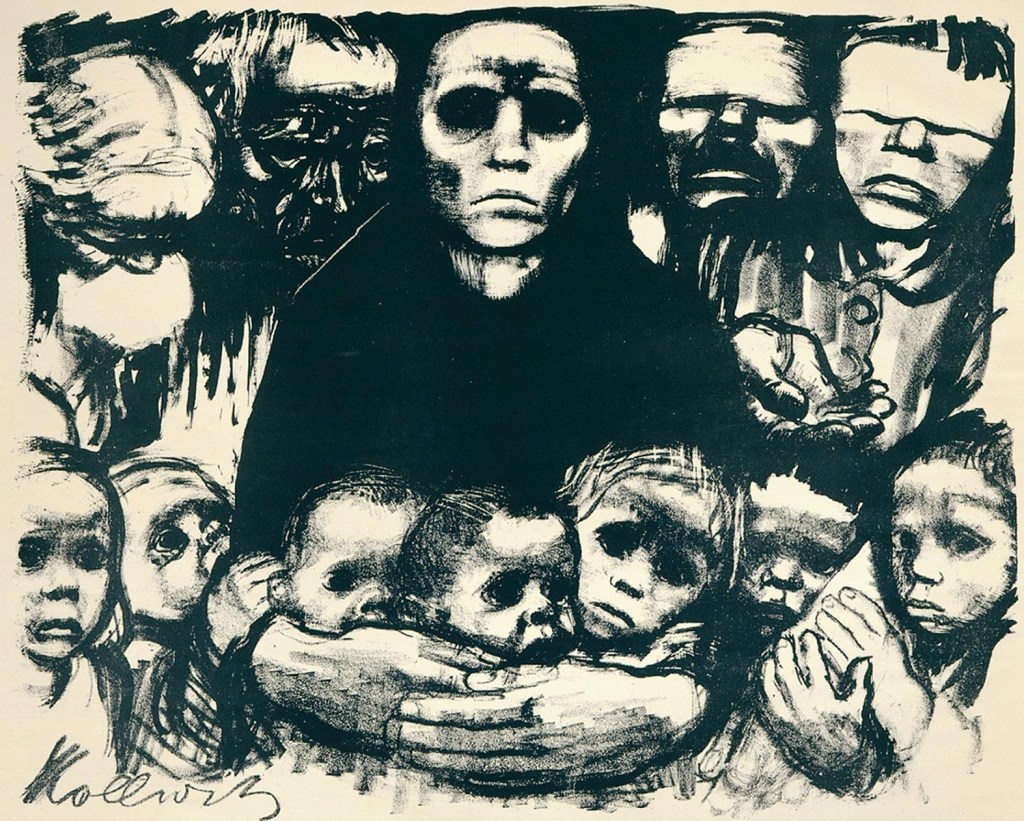
Picture credit: Kathe Kollwitz, The Survivors (1923). Asked to design a poster for the first international anti-war day in 1924, Kollwitz chose to depict a group of survivors of the First World War. Brailsford interviewed similar people as he traveled across central and eastern Europe in early 1919.

