This essay is about incivilimento, the process whereby a people becomes civilized. The subject interested Italians, who in the early nineteenth century worried that their country, once considered the epitome of civilization, had fallen hopelessly behind other European nations. In 1832, the philosopher and jurist Gian Domenico Romagnosi published his Dell’indole e dei fattori dell’incivilimento, an extended essay in which he presented civilization as a complex system of government and law, agriculture and commerce, arts and letters that enabled people to prosper in a polite and well-ordered society. Romagnosi’s understanding of what it meant to be civilized was steeped in Enlightenment thinking, which was not surprising given that he had once served in Italy’s Napoleonic administration, and it represented an ideal that contemporary Italy had largely failed to meet. In his essay, Romagnosi pointed out that a century and a half of war and plague, venality and corruption, superstition and ignorance had prevented Italians from keeping pace with their neighbors to the north.
Incivilimento also provided Carlo Cattaneo (1801–1869) with a subject for reflection, particularly in the decades before 1848. Cattaneo’s understanding of civilization and the conditions that made civility possible drew heavily on Romagnosi’s teaching and emerged most clearly in his writings on Lombardy, for where Italy as a whole might have failed, Lombardy as a province had largely succeeded. Cattaneo, who was born and raised in Milan, always viewed his Lombard heritage with pride. In the 1830s and 1840s, he wrote a number of articles on the region that culminated in the Notizie naturali e civili su la Lombardia, in many ways a showcase of Lombard achievements. As the title of this work suggests, Cattaneo drew a connection between nature and civility. Societies, he suggested, existed within natural environments that had to be tamed and made productive before civilization was possible. Nature provided them with both opportunities and challenges. Societies that enjoyed high degrees of civilization did so because they had learned how to take advantage of the opportunities in order to meet the challenges: they had terraced hillsides for vineyards, channelled rivers for irrigation, cleared forests, drained swamps, leveled fields. Taming nature in this way required the work of generations, and Cattaneo often spoke of civilization as an inheritance. Each generation picked up where its forebears had left off, holding their achievements in trust for future generations, adding to their value and being careful not to squander what had taken centuries to accumulate. By improving the land, embodying practices in institutions and codifying customs into law, Cattaneo’s Lombard ancestors amassed over centuries the labor and wisdom that made civilization possible.
Cattaneo’s reflections on Lombardy made a strong argument in favor of the region’s uniqueness. A people and a land, he told his readers in one article after another, gained their shared identity through the process of becoming civilized. The geography of the Po Valley and the ingenuity of the Lombards had conspired to create a unique form of irrigated agriculture that had imparted to the region its characteristic landscape, its unique institutions, customs, and laws. This essay, then, is also about the land and about Cattaneo’s conviction that Lombard civilization could not be separated from the land that had nurtured it.
1
Brianza, an area north of Milan, in the foothills of the Alps. Cattaneo’s appreciation for the region reproduced in miniature his appreciation for Lombardy as a whole. In a short article, written for the Annali universali di statistica in September 1836, he sang its praises, admiring in particular its hills, lakes, and rivers. Cattaneo considered Brianza culturally on a par with Fiesole, the hill town outside Florence. He associated Brianza with a number of Lombard cultural figures: the poets Giuseppe Parini, Vincenzo Monti and Ugo Foscolo; the painters Andrea Appiani and Giuseppe Bossi; the architects Luigi Cagnola and Giuseppe Zanoia; the philosophers Gian Domenico Romagnosi and Pietro Verri; the scientists Alessandro Volta and Paolo Frisi. Brianza, Cattaneo wrote, was beautiful, industrious, prosperous, and its countrymen were admirable. In his article, he provided a thumbnail sketch of the region, moving from nature, to the built environment, to manners:
In the background of the scene, the naked and jagged summits of the Resegone and the glacier of the Moncodine; and soon mountains, green all the way to the top, which are mirrored in shady lakes; villas adorned with high cypresses, olives and pomegranates; beautiful and innumerable roads along ravines and slopes; towns prosperous and industrious by silk manufacturing; countrymen who are cordial, not brutal, not rapacious, and extravagant in welcoming every passerby.
The sketch is noteworthy because it reveals Cattaneo’s priorities. He began with the sublimity of the Alps, but soon focused on what interested him most: the villas, orchards, roads, towns, and industries that underlay the prosperity and friendliness of the local population. Brianza, with its philosophers and poets, artists and scientists, owed its civilized existence to the resourcefulness with which its inhabitants had subdued the mountains and rendered them productive. Here, in miniature, was Cattaneo’s approach to incivilimento.
Cattaneo emphasized in his writings on Lombardy that every society developed within a specific natural environment, and that the challenges and opportunities provided by nature combined with the genius of a region’s people to create a unique set of practices, institutions, customs, and laws. This emphasis on the physical environment’s tendency to shape distinct social arrangements may have owed something to Enlightenment ideas that were common currency at the time. Montesquieu’s Spirit of the Laws (1748) had stressed the effect of climate and other natural forces on both people and governments. Herder’s Another Philosophy of History (1774) had attributed the wonderful diversity of human cultures in part to the various physical conditions out of which they emerged. Cattaneo had also certainly learned from Romagnosi, who had taught that institutions developed as people met the challenges that their physical environments imposed on them. His Della ragion civile delle acque (1830) had demonstrated how the need to regulate the water supply in rural economies like the Lombard had brought communities together and shaped their civil laws. But most of all, Cattaneo’s focus on the physical environment expressed his Lombard pride, his conviction that his countrymen had taken their specific natural surroundings and, through centuries of hard work, native ingenuity, and capital investment, had turned them into something remarkable and unrivaled. The singularity of the Lombard achievement provided the keynote for everything he wrote on the region, beginning with his first article for the Politecnico (1839), “Sulla densità della popolazione in Lombardia,” in which he pointed to Lombardy’s large, stable population as an indication of the region’s prosperity and level of civilization.
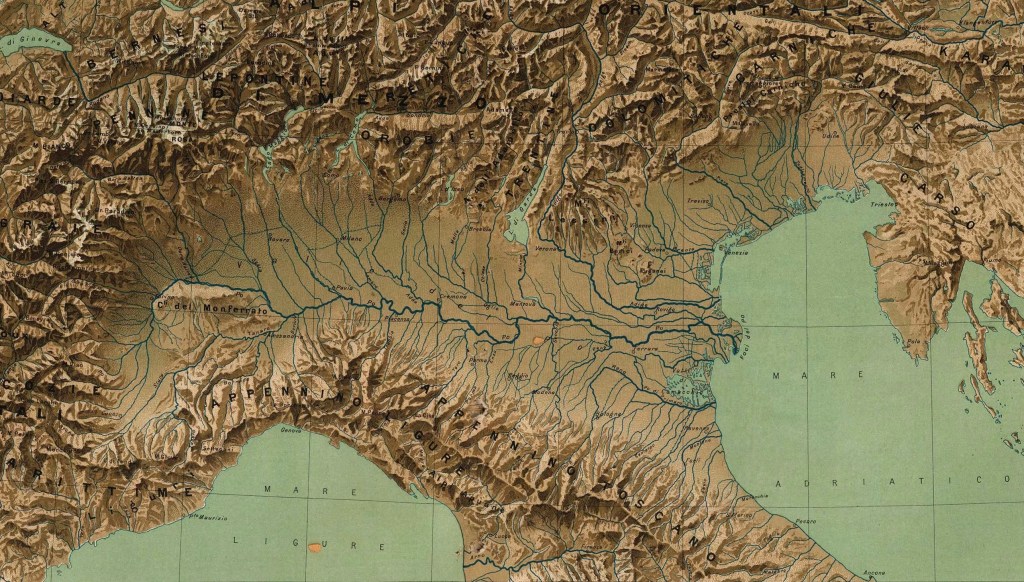
The physical geography of the Po Valley provided the setting for the Lombard achievement. Cattaneo described this environment as a “vast agrarian machine” waiting for the ingenuity of his countrymen to put its wheels—its mountains, lakes, rivers, and plain—into motion. To the north, the Alps rose majestically, straddling the border with Switzerland and Austria, stretching roughly from Monte Rosa (elevation 4,600 meters) in the west to Monte Adamello (3,500 meters) in the east. The Alps influenced the development of Lombard agriculture in a number of significant ways. In the far north, in the province of Sondrio, the Alpine slopes supported vineyards, pastures for cattle, and forests for timber. By drying the moist winds as they passed over from the west, the Alps also gave rise to the mild climate of the Po Valley, hot and arid in summer, with plenty of sunshine, perfect for farming based on irrigation. But most important, the Alpine snowpack and glaciers provided the valley with a constant source of abundant water. Four great lakes—Maggiore, Como, Iseo, and Garda—carved into the base of the mountains, collected the runoff and fed four great rivers—the Ticino, Adda, Oglio, and Mincio—that flowed southward, crossing the Lombard plain and emptying into the Po. The great lakes never froze, their cold waters sinking to the bottom, their warm waters rising to the top, creating temperate microclimates that allowed olive and lemon groves to thrive along their shores.
The rivers and plain completed the agrarian machine. What was most distinctive of the region, and what excited Cattaneo most, was the vast irrigation works that had turned Lombardy into one of Europe’s most fertile gardens. The unique geology of the Po Valley made this irrigated agriculture possible. The rivers dispersed the Alpine water over the plain, where a complex network of canals brought it to the fields. The uniform slope of the land, angled gently toward the Po and the Adriatic, ensured that the water flowed naturally from field to field, without the use of pumps, and at a grade steep enough to avoid stagnation, but gradual enough to prevent erosion. The region’s subsoil, a porous mixture of sand and gravel, allowed water to flow underground, providing a subterranean source that farmers collected in wells known as fontanili. Water from these wells reached the surface at a constant temperature that was warm enough to irrigate meadowland in winter. Lombard meadows supplied with water from fontanili stayed green all year round.
In all his writings on Lombardy, Cattaneo exhibited an immense pride in both the region’s physical environment and the particular genius of the people who had figured out how to render it productive. Lombardy’s most striking feature was its system of irrigation, an arrangement that put all its natural features to use and was a marvel to French, British, and Russian engineers: “We can show foreigners our plain, all displaced and almost rebuilt by our hands…,” he wrote in the Notizie su la Lombardia. “We have taken water from deep riverbeds and from receding marshes, and we have spread it on the arid land. Half of our plain, more than four thousand kilometers, is provided with irrigation; and there, through man-made canals, a volume of water, valued at more than thirty million cubic meters, circulates every day. One part of the plain, by an art that is all ours, is green even in winter, when all around everything is snow and ice. Waterlogged lands are changed into rice fields; so that, at the same latitude as the Vendée, as Switzerland, as the Crimea, we have established an Indian cultivation.” Cattaneo also recognized that the Lombard achievement was unique, that it could not be replicated elsewhere because no other part of the globe shared the same physical and social features. When asked by the British government whether Lombard irrigation could be transferred to Ireland, Cattaneo expressed doubt. Lombard agricultural practices, he explained, were an ancient growth, rooted in specific environmental conditions, sustained by habits and customs acquired over thousands of years. Here Cattaneo provided yet another example of his particularism, his belief that different circumstances in different places would always yield different results. Lombard irrigation could not be relocated to Ireland precisely because all things Irish—environmental conditions, farming techniques, customs and habits—were unique to Ireland.
2
For Cattaneo, the landscape of the irrigated plain epitomized Lombardy’s exceptional achievement. The historian John Stilgoe has suggested that people create landscape when they transform wilderness into the built environment. Landscape, it follows, becomes a representation of civilization because it exhibits how society has tamed nature, how it has imposed order on wilderness. Cattaneo in his observations on Lombardy drew a sharp distinction between wilderness and civilization: “Since the destiny of man was to live by the sweat of his brow,” he told an audience in 1845, “every region is distinguished from wilderness in this, that it is an immense deposit of effort. This effort constructed houses, embankments, canals, roads. It has been perhaps three thousand years that people, bent over the fields of this primitive heath, have been clearing it of the relics of its native rudeness….” Lombardy, Cattaneo concluded, was above all an “artificial fatherland.” It was a civilized land shaped by human artifice and its landscape—its houses, embankments, canals and roads—was a measure of its civilization.
If visitors to Italy in the early nineteenth century had traveled south from Milan to Lodi, what landscape would they have encountered? Arthur Young, the English agronomist, as part of his effort to survey continental farming practices, made the trip in 1789, journeying “through twenty miles of such amazing exertions in irrigation, that we can have in England no idea of it.” After spending a night in Lodi, he ventured on to neighboring Codogno, “through fifteen miles of dead flat.” Everywhere the plain was divided into small fields, bordered not by hedges as one might expect in England, but by irrigation ditches with “a row of pollard poplars and willows on each side.” The country was so wet that it was better suited for “cows and frogs,” he decided, than for people:
The whole is a water sponge; the ditches innumerable; now water, now mud; the climate hot.… I figured sickness and disease in every quarter: and the want of scattered habitations renders the whole silent and solitary, in spite of a considerable population, that is concealed by the endless pollards. Willows, ditches, mud, and frogs!
Richard Baird Smith, an English military engineer, made the same trip in 1851, half a century later. His superiors had sent him to Italy in order to study its irrigation works for possible application in India. He described the trip to Lodi:
The fertility of this district is remarkable, even in Lombardy; and the eye ranges with delight over field after field of the richest meadows.… There is not much of the picturesque in these green plains, broken and bounded by trees which are pruned into most unseemly forms, and studded with isolated cascine, or farm-houses, with but few pretensions to artistic effect; but the rich productiveness that was indicated on all sides was pleasant to contemplate, and the landscape had its own special associations, which, though not free from pain, were full of interest.
So, what would a visitor have seen? A fertile plain, made up of tightly-packed fields. Water meadows, where fontanili allowed for winter irrigation, produced forage crops year round for the dairy industry. Fields unsuitable for winter cultivation yielded rice, flax, wheat and other cereals (rye, millet, maize.) A complex network of irrigation canals, lined with poplars and willows, followed the roads and marked out the fields. Isolated farmhouses dotted the landscape. Flat, green, wet, monotonous, quiet, lonely: such was the Lodigiano, one of nineteenth-century Europe’s most fertile regions, south of Milan.
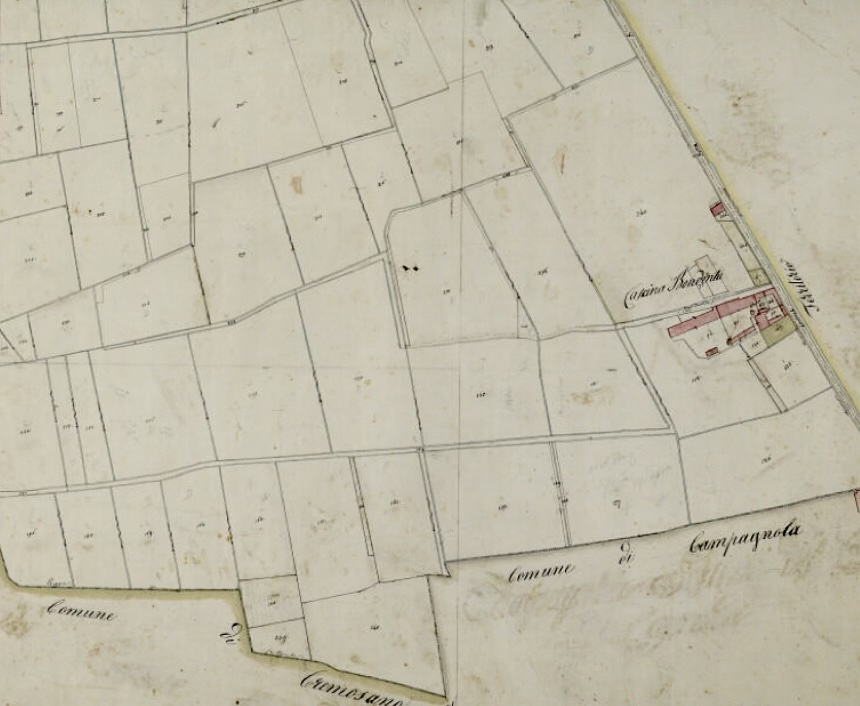
This cadastral map of Cascina Bondenta, a typical farm outside of Crema, provides a two dimensional view of the landscape of the irrigated plain. The map dates from 1832 and depicts the farm located on the strada comunale heading north from Crema. The farmstead (in red) is a substantial structure, facing inward on a series of yards that open onto the fields beyond. The farm stands alone and is surrounded by numerous small fields, a visual representation of what Cattaneo meant when he spoke of the “rural and solitary life” of the Lombard farmer. The lines delineating the fields represent an intricate network of irrigation canals, some of which run in pairs. The squiggly arrows, barely visible, indicate the flow of water.
Had Young or Baird Smith looked more closely, they would have discovered behind the poplars and willows farms of such size and complexity that they amounted to entire rural communities. By the early nineteenth century, sharecropping—what the Italians termed mezzadria—had largely given way to a form of tenancy. Arthur Young had already noted the passing of mezzadria when he made his trip through Lombardy in 1789. By Cattaneo’s time, a class of substantial proprietors owned the land and leased it to farmers, who oversaw the daily business of cultivation and hired an army of laborers to do the heavy work. These establishments tended to be large by the standards of the age, and the farmers needed to be men of means since their enterprise required a sizable capital investment in livestock, vehicles, machinery, tools, stocks of grain, hay, straw, manure. Cattaneo described the arrangement in the Notizie su la Lombardia:
In the irrigated plain, a farm that does not have a certain spaciousness cannot be cultivated with profit, because it requires intricate crop rotations, multiple plantings, difficult distributions of water, and an intelligent family that can manage the complicated business; therefore every farm forms a considerable patrimony. The family that possesses it is already too well-off to be satisfied by this rural and solitary life in unpleasant places; it resides therefore in town; it summers in the sunny hills and on the lakes; and often it knows barely by name the latifundia that nurtures it in this idleness. Cultivation passes to the hands of a tenant, who, in order to run the business properly, must be a capitalist as well; some of them are richer than the proprietors, and sometimes they are possessors of other lands, entrusted to other cultivators. Living amid every domestic abundance, surrounded by numerous families and horses, they almost form a feudal order amid a crowd of day laborers, who know no other masters. Here arises a social order absolutely particular.
The farmsteads that dotted the countryside and sustained this unique social order were substantial structures, capable of accommodating as many as twenty working families. They consisted of large rectangular buildings, several stories high, surrounding several courtyards, open on one side. The entire complex faced inward on the yard, which served as the center of activity, and included many different spaces assigned to a variety of purposes: the farmer’s residence, easily distinguishable from the rest, living quarters for laborers and their families, cowsheds and stalls, hay barns and storage sheds, workshops for making and repairing equipment, chambers for processing the harvest, a dairy. Some large farmsteads might have housed a forge, a laundry, a chapel, an inn, a school. The cascina of the irrigated plain, in other words, enclosed a self-contained world.
Canals were Lombardy’s greatest feat of engineering. The ability to harness water, perhaps the province’s most valuable resource, underlay its prosperity and rise to civilization. Canals drained swamps and irrigated the plain, thereby preparing the land for agriculture. They facilitated transportation and the passage of goods from city to city, region to region. They flowed with a force capable of powering silk, cotton, and woolen mills. The capital accumulated in the cities was used to build canals, and the revenue from canals returned to the cities, where it financed agriculture and manufacturing. For Cattaneo the Lombard waterworks dated from time immemorial. The Etruscans, he noted, embanked the Po to prevent it from flooding neighboring fields; Virgil referred to irrigation in the Bucolics; and the canals, farms, and villages of the irrigated plain all bore Roman names. But the real feats of hydraulic engineering came much later. In a long article written for the Politecnico in 1841, Cattaneo set aside a number of Lombardy’s canals for special mention. Particularly important for both navigation and irrigation were the large canals that connected Milan to the Ticino, Adda and Po rivers. The oldest of these waterways, the Naviglio Grande, dated from the twelfth century, flowed 50 kilometers from the Ticino to Milan, provided a vast quantity of water for irrigation, and transported considerable freight traffic from as far away as Lago Maggiore on the Swiss and Piedmontese borders. Two other canals, the Naviglio della Martesana (39 kilometers long) and the Naviglio di Pavia (33 kilometers), tied Milan to the Adda and the Po. The Naviglio Interno, which followed the ancient ditch around Milan and facilitated the movement of goods throughout the city, completed the network. It joined the Martesana from the north with the Grande and Pavia from the south, thereby uniting Lago Maggiore, Lago di Como and the Po in a single navigational system with Milan located at the hub.
Lombardy’s rivers and great canals provided water for an elaborate system of irrigation that defined the landscape, encouraged the development of specialized technologies, and shaped social practices and institutions. Irrigation canals followed the roads and marked the borders of fields. The streams of water, Cattaneo marveled, “flow at diverse levels with calculated velocities, meet each other, overtake each other on canal-bridges, pass under each other at siphons, are intertwined in a thousand ways. In the space of only two hundred paces, near Genivolta, the road from Bergamo to Cremona meets thirteen aqueducts, and crosses over them with Thirteen Bridges.” Specially designed outlets distributed fixed quantities of water from primary to secondary canals according to elaborate schedules. Fields received varying amounts of water depending on their use. Prati stabili, or stable fields, which grew forage crops and grains in complex rotations, called for only periodic irrigation, whereas rice fields needed to be submerged from sowing to harvest. The famous marcite, or water meadows, capable of supporting forage crops throughout the year, required a tremendous amount of water, some from canals, some from fontanili, since it flowed continuously day and night, week after week, all year long. For Cattaneo, the marcite represented the height of Lombard ingenuity. Farmers had learned to slope the fields at a precise incline so the water, entering from a channel at the top, flowed uniformly over them. Farms usually maintained an assortment of fields, so the water was put to multiple uses and never wasted as it circulated from one application to the next, before returning to the canal and moving on to the next farm.
The extensive use of irrigation ensured that Lombard agriculture was a social undertaking. Its essential activities—building and maintaining canals, buying and selling water, negotiating distribution schedules—were all communal transactions regulated by custom and law that encouraged people to work together. Farmers might pursue their own interests, but the need for water united them in a cooperative effort that promoted civility. The water that flowed through large canals like the Naviglio Grande belonged to the state and was made available for the public good. In order to achieve the greatest social benefit, communities would decide, often basing their decisions on immemorial custom, how best to supply water so as to disturb neighboring fields as little as possible. Farmers in need of water could appeal to the sentiero dell’acqua, the right of access rooted in Roman law that allowed for the placement of irrigation canals across private fields so long as the landowner received fair compensation. The sentiero dell’acqua had entered Lombard property law as a servitude, or easement, whereby the proprietor remained in possession of the land, surrendering only its use. Engineers would survey the canal’s proposed route, making sure it was placed so as to inflict the least possible damage on existing canals and fields. The proprietor would receive remuneration for the value of the land that the canal displaced plus a markup of a quarter. As an additional benefit, the promoters of the new waterway were expected to plant trees along its edges, in order to consolidate its banks, shade the water’s surface to prevent evaporation, and provide a supply of firewood. The sentiero dell’acqua, as it had evolved over generations, was a right available to all regardless of wealth or social standing. The principle behind the practice, Cattaneo explained: “one must do for others that which, in a similar case, others must do for him.”
In addition to the sentiero dell’acqua, other Lombard conventions promoted the public good and laid the groundwork for civil society. Engineers drew up schedules (known as rote d’acqua) that established the amount of irrigation available to each farm, the times of its distribution, and its cost. They prepared detailed inventories (consegne) that described the condition of farms at the moment when tenants took up their leases. The custom of reimbursable improvement (miglioramento rimborsabile) guaranteed that landlords compensated their tenants for investing in their lands and improving them. On the termination of a lease, landlord and tenant referred to the farm’s original inventory in order to identify those improvements that required reimbursement. The social benefits of these conventions, Cattaneo claimed, were indisputable. The rote d’acqua prevented disputes from arising when many farms depended on water from a single canal. The consegne and custom of miglioramento rimborsabile smoothed relations between landlords and tenants. The knowledge that they would be reimbursed for their efforts encouraged tenants to treat their farms as their own property and to undertake longterm investments that increased the land’s productivity and brought prosperity to all. Finally, the Lombard fiscal system further encouraged improvements to the land. By apportioning taxes according to the land survey (censo) carried out during the reign of Maria Theresa, the Austrian authorities intentionally exempted from taxation the value added to properties by subsequent investment and improvement. In this way, Cattaneo concluded, “everyone is pushed to increase revenue with even the slightest investment of capital.”
What the Lombard landscape revealed to Cattaneo, behind its monotonous facade, was a vibrant civil society. The farms that dotted the countryside were capitalist enterprises and the need to irrigate brought people together in reciprocal relations that were cordial, orderly, and cohesive. This last point was important. Missing from Cattaneo’s account was any indication of the labor exploitation and class struggle that future commentators would place at the center of Italy’s capitalist agriculture. Missing also were references to the prevalence of disease and poverty that both Arthur Young and Richard Baird Smith alluded to in their descriptions of the region. “I figured sickness and disease in every quarter,” Young had noted; and Baird Smith, as he looked out over the countryside, would refer to “associations” that were “not free from pain.” It goes without saying that Cattaneo’s portrait of Lombardy was idealized as he was determined to showcase the province’s achievements. The need to tame the physical environment, he told his audience in one article after another, had united a wide variety of people, practitioners of many different trades—farmers, engineers, accountants, lawyers, laborers specializing in all the recondite skills that agriculture required—in a cooperative effort to shape the land and render it productive. The growth of civilization, in other words, had brought social harmony and prosperity, not discord and impoverishment.
Cattaneo’s account of the Lombard countryside, of its agricultural practices and social arrangements, of the forces that shaped its singular landscape, was also highly historicized. Civilization, he demonstrated, was not static, it was not a stage to be reached, but a developmental process extending over centuries, as each generation added its wisdom to the accomplishments of its ancestors, refining the customs and traditions that enabled them to prosper. In the case of Lombardy, the interaction between a specific natural environment and a specific people, conducted over an immense expanse of time, had led to a unique result—an “absolutely particular” social order, one found nowhere else. Cattaneo’s approach was also highly conservative, especially given its immense respect for the past, and might appear at first to contrast strikingly with the utilitarian radicalism of his writings on crime and poverty. Consider the differences. His Benthamism was primarily deductive. He affirmed the principle of utility and then judged laws or policies accordingly: to what extent, he asked, did they promote the greatest good for the greatest number of people? His writings on Lombardy, on the other hand, were primarily empirical. He discovered what already existed, described customs and practices that had developed over the centuries, and then marveled at how well they worked. But the tension between these two approaches was more apparent than real, for Cattaneo managed to combine them both. Allowing customs and practices to grow over time, as each generation added its wisdom to that of previous generations, became an effective way to guarantee that the resulting laws and institutions achieved the greatest good for the greatest number of people—so long as one had patience, for the process was slow.
3
For Cattaneo, agricultural productivity drove civilization forward. The proprietorial class extracted wealth from the land in the form of rent and spent it in cities, funding the institutions and people whose accomplishments made life worth living. In many respects, Cattaneo seemed to echo the Physiocrats, French economists of the previous century who argued that only labor applied to the land created national prosperity. For François Quesnay and his followers, agriculture alone yielded a disposable surplus. Manufacturing and commerce helped to circulate wealth, but added nothing to it. Farmers marketed their produce, passed their surplus on as rent to landowners, who then spent it by consuming manufactured goods. Government policy, it followed, should encourage investment in the land because agriculture alone served as the engine that powered the economy. But to read Cattaneo’s essays on Lombardy as mere Physiocracy would be wrong, for Cattaneo did not ignore the role that commerce and manufacturing played in generating wealth. His economic thinking, in fact, owed far more to Adam Smith than to François Quesnay. If his appreciation of Lombardy appeared to place undue emphasis on agriculture, it was because he was analyzing an overwhelmingly rural economy. In telling the story of Lombardy’s economic development, Cattaneo focused on the agriculture that actually existed, rather than on the industry whose growth he wanted to encourage.
A reciprocal relationship between town and countryside lay at the heart of Cattaneo’s economic thinking. To be productive, the land required investment. Lombard farmers, Cattaneo said, needed to be capitalists with sufficient resources to keep their enterprises going. Buildings, implements, vehicles, livestock, feed for animals, seed for the harvest, wages for labor—all had to be procured and maintained. But the land also required improvement. Excavating irrigation canals, planting trees to consolidate their banks, leveling fields, draining swamps, constructing farm buildings, laying out roads and bridges—these projects demanded considerable time and money. In Italy this long-term investment had historically come from cities. In his “Notizia economica sulla provincia di Lodi e Crema,” an extended essay written for the Politecnico in 1839, Cattaneo sketched the history of the Lombard plain south of Milan. He began with the Etruscans, describing them as a maritime and commercial people who congregated in cities and gave an impetus to agriculture. He concluded: “Among us commerce anticipated agriculture, whose master and father it was. Agriculture came out of the cities. This action of the municipalities on the countryside is the key to all Italian history.”
This insight linked Cattaneo to Adam Smith and the Scottish Enlightenment. In the Wealth of Nations (1776), Smith had noted that in Europe manufacturing and commerce, both of which took place in cities, had given rise to agriculture. Theory might suggest otherwise, that food production should have come first—after all, people must eat before they can make and trade goods—but in fact this had not been the case. Commercial and manufacturing towns had encouraged farming by providing markets for agricultural produce. Wealthy townsmen, aspiring to country life, had invested in land, purchasing and improving uncultivated areas. Finally, towns brought law and order to the countryside. Smith concluded: “It is thus that through the greater part of Europe the commerce and manufactures of cities, instead of being the effect, have been the cause and occasion of the improvement and cultivation of the country.” He then applied this observation to Italy: “Italy is the only great country of Europe which seems to have been cultivated and improved in every part by means of foreign commerce and manufactures for distant sale.” Here, then, was an anticipation of Cattaneo’s insight that the interaction of town and country provided the “key to all Italian history.”
In his essay on Lodi and Crema, Cattaneo recounted this history as it pertained to one specific region. When cities thrived, investment flowed to the countryside and agriculture flourished as well. This was the case with the Etruscans and especially the Romans, who first brought irrigation to the Lombard plain. The growth of cities in the eleventh century led to one of the great efforts at canal building: the Naviglio Grande, the Ticinello, the Fosso Bergamasco, and the Muzza all dated from this period. But when cities fell into decline, as they did following the collapse of the Roman Empire and under the Spanish, they brought agriculture down with them. The contrasting fates of Lodi and Crema in the sixteenth century provided a case in point. Constant warfare devastated both cities as the Italian peninsula became the battleground of Europe. But eventually Crema came under the sway of Venice: “commerce flourished; buildings were beautified; swamps were drained; and its territory was brought under cultivation, which in a few years was repopulated with 25,000 inhabitants. It became a refuge for industry and commerce….” Lodi, on the other hand, fell to the Spanish: “the roads and rivers were left to themselves; the public waters, the bridges, tolls, customs duties, the gabelle on bread, on wine, on meat were sold to private individuals; cruel contractors were arbiters of persons and things.…” The consequences were predictable: “small proprietors, their profits not enough to pay half the imposts, abandoned their farms….”
Cattaneo’s tendency to assign economic primacy to Italian cities suggests an even greater affinity with the Scottish Enlightenment. Cattaneo’s teacher and mentor, Gian Domenico Romagnosi, was steeped in Scottish thinking, frequently citing Adam Smith in his writings on political economy, and editing an Italian version of William Robertson’s Historical Disquisition concerning Ancient India (1791). Cattaneo expressed his appreciation for the historical approach taken by the “Scottish school,” and he owned works by Adam Ferguson, David Hume, Robertson, and of course Smith. What is more, Cattaneo and the Scots shared a common purpose, a concern with improvement, with bringing the benefits of civilization to their respective countries. The Scots had thought long and hard about progress, about what it meant to be modern. For readers like Cattaneo, the remarkable accomplishments of the British industrial economy seemed to bear out their ideas.
For Smith and his compatriots, commercial society stood at the apex of modernity. Its citizens enjoyed unprecedented prosperity and freedom, culture and knowledge, politeness and civility. They were prosperous because they benefited from a high standard of living and had access to an abundance of material goods, free because the rule of law protected their right to own property and guaranteed the sanctity of contracts, cultured because the arts and sciences flourished. Commercial society drew strength from a manufacturing economy in which the division of labor increased production and the market facilitated the exchange of goods. Individuals might pursue their own interests, but they also remained highly dependent on one another. In an advanced economy, where labor was divided, cooperation and trade provided the only means for satisfying needs. Relations of exchange, the Scots believed, would lead naturally to sociability and civility. Commercial society, because it brought people into reciprocal relations, allowed for a moral and virtuous life. It encouraged honesty and diligence, frugality and prudence, kindness and generosity. “Commerce,” the historian William Robertson had noted in his influential History of Charles V, “tends to wear off those prejudices which maintain distinction and animosity between nations. It softens and polishes the manners of men. It unites them, by one of the strongest of all ties, the desire of supplying their mutual wants. It disposes them to peace, by establishing in every state an order of citizens bound by their interest to be the guardians of public tranquillity.” For the Scots, commercial society represented the final stage in a process of development that began with hunting and gathering, passed through herding and agriculture, and ended with commerce and manufacturing.
In the Wealth of Nations, Smith not only explained the economic foundations of commercial society, but he provided a historical sketch of how the nations of Europe had arrived there, emphasizing the key moment when commerce as a way of life replaced feudalism. Cattaneo did much the same in his essay on Lodi and Crema, but whereas Smith’s account tended to be schematic, plotting a more or less universal process, Cattaneo’s was specific to Lombardy. His picture was messy, to be sure, but its Smithian outline remained recognizable. For Cattaneo, the feudal order emerged out of the wreckage of the Roman Empire, as the latifundia were transformed into fiefs and their slaves became serfs tied to the land. Economic activity reappeared first among the monasteries, which reintroduced Roman practices, draining swamps and irrigating the plain. Cities regained their independence, trade connected them, and together they improved agriculture: capital flowed to the countryside, land was reclaimed, irrigation extended, serfdom abolished. The revitalized cities, now organized as armed republics, soon challenged the feudal order. “Then was born that intestine battle between town and country, between commerce and feudalism, which took on the name of Guelph and Ghibelline….” For Cattaneo, the Guelphs represented the forces of commerce, of progress; the Ghibellines were the party of feudalism. As Smith had put it in the Wealth of Nations: “In countries, such as Italy…, the cities generally became independent republics, and conquered all the nobility in their neighborhood, obliging them to pull down their castles in the country and to live, like other peaceable inhabitants, in the city…. [This] is the history of all the considerable Italian republics….”
Lombardy, too, acquired the attributes of commercial society, despite the setback in the sixteenth century. With the coming of the Austrians, the province rejoined northern Europe and became modern, following the trajectory charted by Smith in the Wealth of Nations and Robertson in the History of Charles V. Whether Cattaneo was inspired directly by writers of the Scottish Enlightenment, or whether he was developing ideas that were common at the time is difficult to say. But the fact remains: commercial society, much as Smith and Robertson described it, represented his ideal of what it meant to be civilized. When he studied Lombardy on the regional level, describing the land and its people, he may have praised the uniqueness of its achievement. But when he stood back and placed the province in a civilizational context, he showed that it was participating in a more universal pattern of development culminating in commercial society.
Cattaneo ended his essay on Lodi and Crema with an appreciation of Lombardy’s progress and accomplishments. The land census, introduced during the reign of Maria Theresa, and the accompanying property tax, which exempted profits due to improvements, had encouraged agriculture with impressive results: “Ten years did not pass, but one saw vast barren tracts covered with fertile harvests. At the end of the century the commercial value of the Agro Lodigiano had already almost doubled.” The development of Lombard agriculture drove civilization forward. The remnants of feudalism disappeared, property became secure and trade became free, commerce and manufacturing flourished. “The sudden appearance of new French and English goods aroused us from the torpor induced by Spanish protection; and our industrial life began anew. Roads were opened, tolls and barriers to trade suppressed, the distance between cities, which before was crossed only by dint of oxen and in the course of days, was reduced to three or four hours.” Here were the seeds of commercial society and with them came the fruits of civilization: the imposition of law and order, the establishment of justice, the abolition of torture. Lombard society became cultured and refined: “Theaters opened, where families, which had run wild for seven generations, learned how to interact with one another, and were introduced to the sweetness of civil life, of music, of poetry.” In case anyone missed the point, Cattaneo ended the essay with a brief summary. The encouragement that agriculture received from the Etruscans and Romans came to an end with the Middle Ages. But the revitalization of the cities in the eleventh century had made an impact on agriculture, developing irrigation, such that now, seven centuries later, “…in place of fetid swamps and ferocious tribes, we have a region that is everywhere fruitful, peaceful, and populous, ready to embark on the new economic phase that the irresistible course of an adult civilization prepares for it.”
4
Cattaneo, like his mentor Romagnosi, thought of civilization as a process to undergo rather than a goal to attain. Lombardy had achieved much, he affirmed, but there was still more to do. As part of his effort to educate his countrymen, he urged them to follow the lead of northern Europe into the modern age. In a speech delivered in 1845 at the annual award ceremony of Milan’s Society for the Encouragement of Arts and Crafts, Cattaneo pointed the way forward to the “adult civilization” that he had mentioned in his essay on Lodi and Crema. Railways and manufacturing, he said, would soon take their place alongside canals and agriculture. “It is our turn to start on a network of railways, to adorn the night with the light of gas, to pass from the spinning of cotton to the more complicated styles of weaving, to bring every variety of color to the practice of dyeing and printing silk….” Railways, gas lighting, and textile mills—here his audience would have recognized the emblematic features of Great Britain’s industrial revolution.
Lombardy was becoming modern, but in a unique way that set it apart from other places. Foreigners might turn to the province for guidance, and Cattaneo was certainly proud when they did, but outsiders were mistaken if they believed that Lombard practices could be moved easily from one place to another. They were an ancient growth, rooted in special environmental conditions, sustained by habits and practices acquired over the course of many generations. No authority had ever imposed a grand plan for irrigating the plain. To the contrary, the province’s system of irrigation had grown organically, by trial and error, “farm by farm,” and in this way it had come to embody the collective wisdom of the Lombard people. The final outcome was certainly imperfect. “Just as the borders of our provinces and the streets of our ancient cities are tortuous in comparison to the straight lines that we see reign supreme on the maps of the United States, so the meanderings of the water on our fields proves to be convoluted.” But having emerged out of the spirit of the Lombard people, the system worked. “A premeditated design,” he said, would never have tapped into the sources of Lombard “ingenuity” and applied capital to the land with quite the same success.
There was a sense of regional pride in all these reflections, combined with a sense of patrimony, as each generation imparted its wisdom and labor to the land, turning it into something verdant, luxuriant, and prosperous. Cattaneo saw civilization as an inheritance to be held in trust, to be managed as an estate, to be passed on to future generations with long term improvements. “Yes,” he told his audience at the Society for the Encouragement of Arts and Crafts, “a people must build its fields, like its cities.” Given his Lombard pride, it would be easy to read Cattaneo as a simple regionalist, as an advocate of provincial autonomy. This interpretation would appear consistent with his response to Italian unification and his opposition to a consolidated Italian nation-state. In the years after 1848, Cattaneo grew increasingly alarmed that unification would mean the domination of Italy by Piedmont and the House of Savoy, a consequence that he feared would rob Lombardy of its unique identity and smother its native ingenuity, its drive to progress. But to call Cattaneo a simple regionalist would be mistaken, for his Lombard perspective did not preclude a more comprehensive vision of an Italian nation. His goal for Italy, however, was not a consolidated state under the domination of one province or dynasty, but rather a collection of autonomous regions, loosely federated, each free to follow its unique genius. There was no room in Cattaneo’s thinking for centralization, for master plans emanating from the center designed to quell local initiative. In an effort to arouse this federalist spirit, he called on the other regions of Italy to follow Lombardy’s lead and enter, each in its own way, the modern age.
© Timothy Lang | Bainbridge Island, Washington
A footnoted version of this essay can be downloaded here: Lombardy
Picture credit: A detail from an 1899 topographical map of the Alps depicting the Po Valley. The map illustrates the stark contrast between the mountains and the plain. The Po runs the length of the valley, emptying into the Adriatic south of Venice. Four great lakes—Maggiore, Como, Iseo and Garda—appear at the base of the Alps, while four great rivers—the Ticino, Adda, Oglio and Mincio—flow from the lakes to the Po. Cattaneo considered the Po Valley, given the abundance of water, a “vast agrarian machine” awaiting the ingenuity of his countrymen. Le Alpi: Carta Fisica, Cartografia dell’Istituto d’Arti Grafiche, Bergamo (Milan: Hoepli, 1899).


You must be logged in to post a comment.